Friday, 16 May 2014

Why I have little sympathy with James Wallace

In case you're wondering who I'm talking about, James Wallace is the London-based Scot who wants to vote. Not just in any old poll but THIS REFERENDUM. You know? The one happening more than 300 miles away from where he lives. He supposedly has the God-given right to vote in this referendum because he is, well, Scottish.

As agreed in the terms of the Edinburgh Agreement, the Scottish Independence referendum is only open to people who live in Scotland and with good reason. Can you imagine the legal nightmare involved in trying to decide precisely which expats are eligible? Yet this same nightmare is just what James Wallace wants.

The first thing I ought to comment on is the name of his petition, 'Let Wallace Vote'. Why isn't it called 'Let James Vote' or 'Let Mr Wallace Vote'? Surely the voter is supposed to be someone you're on first name terms with like Joe the Plumber during Obama's election campaign some years ago. I can only wonder if this is his way of giving the title a Scottish tone since Wallace has obvious connotations in a debate about Scottish independence i.e. Scottish patriots.

 
Let Wallace vote

Now I don't question his patriotism for Scotland. And Mr Wallace I'm sure is a nice guy, possibly the sort I'd want to have a bit of Premier League footy banter with at the local pub, as long as he doesn't talk about Chelsea (I'm a Liverpool fan you see)! In all sincerity it's good that he has found a job in London, always reassuring to know that there are plenty of home-grown graduates who have made it far and wide. If I was one of his family I would be very glad for him in having found a desired career. But Mr Wallace lives in London and will be there indefinitely which means he is not directly contributing to Scottish society, he is not paying taxes in Scotland, he is not subject to the many issues affecting Scotland which may or may not affect the south of England and won't be anytime in the near future. So why should he have the vote when democracy is about people being able to make decisions about the very communities where they live? He would accept that he has no right to vote in Holyrood elections as he doesn't live there and nor even a referendum for further devolution if Devo-max and not independence had been the Yes option. So there had better be a very very good case for that to be different with the independence referendum.

Which leads us neatly to the question, What is James Wallace' case for wanting the vote? Well to answer the question I should perhaps dissect a little his petition calling on expat Scots to be given the vote. Because it's not that long I thought I might as well copy and paste it here:

I'm James Wallace.
I, along with over one million future Scottish citizens will not be able to vote in the Scottish Referendum on Independence due to take place on 18 September 2014.

I was born in Scotland, all my family live there, I have lived there all my life until I moved to London in 2012 to start my career, I will return.  I'm Scottish. if Scotland becomes independent I automatically will become a Scottish citizen but I have no say in this decision. Never before has a vote for independence been based on a franchise like this. 

Scotland needs to encourage its workforce to be international, to learn, and to bring this knowledge back to improve our nation.  In its history Scots have explored, ventured to new areas in the world and then improved our country.  They should not be denied a vote on their future.

I have obtained a legal opinion stating that excluding all non resident Scots is illegal.  I have called on the leaders of all parties to come together to ensure that the legality of the referendum cannot be challenged either before or after the independence referendum. 

James Wallace

  Example: if I lived in New York (or anywhere else in world) I could vote for my Scottish MP in westminster elections. But under these rules would not have a say on whether i get that vote in the future. This makes the referendum franchise rules undemocratic. Fact.


So there it is. James Wallace wants to vote because with Scottish independence he will 'automatically become a Scottish citizen'. He's right - to an extent. Under the plans listed in the White Paper anybody who was born in Scotland before and beyond independence day will be regarded as a Scottish citizen. I would say it's a spiritual prerogative to have the citizenship of the country where you were born. But has James Wallace heard of the right to renounce citizenship if you don't want it? Ah, see my point? You can renounce UK citizenship by politely saying to Teresa May, 'you can take this citizenship of mine and you can shove it up your proverbial backside, preferably before your lot brings back conscription for all healthy male British citizens between 16 and 40'. Likewise you will be able to renounce Scottish citizenship if you so wish. So James, if you don't like being a Scottish citizen then by all means renounce your Scottish citizenship. But why would James Wallace want to give up his Scottish citizenship? Well, possibly he's a little suspicious of Alex Salmond. Oh well, that would be his problem.

But I'm sure he wouldn't renounce his Scottish citizenship, he would embrace it with pride. Like I will too as someone who is NOT Scottish but will be normally resident in Scotland on day one of independence. However, I've only touched on half of James Wallace' paranoia about his citizenship. The other half appears to be a belief that by becoming a Scottish citizen he will then lose his British citizenship, well that's his implication anyway. But how would that work exactly? Would the Met come round to his house in the middle of the night and seize his passport in complete breach of his human rights? Oh but wait a moment, I'm just having a little look at some comments on the campaign's Facebook page and they appear to be saying it's Alex Salmond who wants to take away their UK citizenship! No sorry but that's just taking the piss now. For that to make any sense you're looking at a rather ridiculous Interpol operation!

As is made clear in the white paper the Scottish Government's intention is to let Scottish citizens hold dual citizenship with the UK if they wish. That's hardly Alex Salmond 'wanting to take away people's British citizenship'. As the current rules state any British citizen who wants to hold dual citizenship with another country can do so as long as that country allows it. Again you would have to be questioning Alex Salmond's wish to let people hold dual-citizenship to question that rule applying to Scotland and its citizens.

So then what really is left of James Wallace case for getting the right to vote in this referendum? That he may be returning to Scotland sometime? So what? You may be returning? May be? When? If you haven't got any arrangements made to move back to Scotland  how can we know your intentions? How are the Electoral Commission supposed to know? And so what if you're moving there and have family there? I have some family down in Surrey, my maternal Grandmother for one. I would rather there was no prescription charges down there but should I be able to do anything about that through the ballot box? Of course not, I don't live there, it's not my business, it's for my Gran and others like her in England to cast her vote to help get the right government that will abolish prescription charges. It is for my Gran, not me, to elect the councillors that will make the right decisions on a local level in Surrey council. And it is for my Gran, not me, to vote in any local referenda including devolution for Surrey. Of course devolution for Surrey as a wealthy part of London's commuter belt is a little pointless but you get my point. As someone born in Oxfordshire, should I have a vote in a similar referendum down there, one for devolution for Oxfordshire? No I shouldn't because I don't live there! Nor should my Mum, who was born in what is now southwest Greater London, be entitled to vote in the London Mayoral Elections.

The referendum on Scottish independence is about further powers for Scotland albeit the maximum amount of further powers. It is the people living in Scotland who will be directly affected by the result of the referendum. People are not voting in this referendum merely on the idea of national identity or citizenship, they are voting on how empowered they wish to be in the country where they live. What James Wallace wants is for some 500,000 to 1 million people living outside Scotland to decide how empowered people living in Scotland should be. Think about that for one moment. If a majority of say 100,000 over the rest of the voters living in Scotland, feel the best interests for themselves are to have the MSPs they elect to represent them in the Scottish parliament making all of the decisions at a national level that affect them then why should that voice be cancelled out by some 200,000 who are not affected by what goes on in the Scottish parliament who are not represented by and do not elect any MSPs?

Whatever your view on independence many people in Scotland feel this is a fantastic opportunity to be able to live in a country free from the mess of Westminster. It would not be fair that they lose out simply because of people who most likely will be voting No on a rather vague and irrational fear about their supposed citizenship status. Although they will be able to read the Herald and Scotsman online, generally speaking people south of the border, Scots or not, will be a lot less well informed of the debate because there is not going to be the same access to the level of coverage with this referendum that we get north of the border. They won't be getting leaflets through their door, they won't be able to pop along to any public meeting unless they live near the border, they won't be passing Yes or BT stands when out shopping and they won't have STV on their TVs. They can have a valid and strong opinion but it would likely pale into insignificance compared to the minds that are made up north of the border. The Scots south of the border are British citizens living in what will be considered the continuing UK. So what on earth can the reasoning be for them losing that citizenship? That the UK won't allow dual citizenship with their nearest and dearest neighbour while allowing it with all other countries? Well if anything that would sound like little more than revenge and can be challenged in a court of law where the UK government would lose. For sure.

I said I have little sympathy with James Wallace. Well, to be generous I'll add an indefinite article. I do have a little sympathy with James Wallace. It is understandable that he'd love to be part of such an important decision about the country of his birth. Of course he will have strong views on what best for the citizens of Scotland that live there and may have good reasons for those opinions. But he doesn't live in Scotland and far from having to change his citizenship, he will be able to hold Scottish citizenship jointly with UK citizenship. That should be seen as a bonus, a privilege rather than an obligation. So if Mr Wallace wants to choose not to hold Scottish citizenship he will have every right to do so following independence. But why do it through potentially outvoting the resident population of Scotland in their decision about what sort of country they want to live in? The least he should do to make his campaign remotely convincing is to include someone who would vote Yes especially if they are voting Yes for a better future for their family back home. Otherwise his campaign comes across as little more than an attempt at gerrymandering which is no doubt an accusation he's levelling at the Scottish Government!

Also as I touched on at the start Mr Wallace is entering legally dangerous territory since it will still be unfair for some people. Because who on earth do you define as Scottish expats? Yes James Wallace is certainly one of them, he ticks all the boxes in being Scottish other than residency not least because he was born in Scotland. But what about if I myself moved down to England and James Wallace has his way? Would I be allowed to vote? No I wouldn't because I neither live in Scotland nor was born there. Yet I've lived in Scotland longer than possibly than James Wallace has been alive! That's right, if James was born after March 1988 he was born after I moved to Scotland. I moved up when I was only three I spent the majority of my school education in Scotland including all of primary school. I call Galloway my home, before moving to Edinburgh, Newton Stewart was my local community. I still feel it is. I far more naturally take pride in the local talents of where I live than the ones that hail from Oxford where I was born. I've noticed James Wallace having the cheek to comment on the "French people living in Scotland can vote but not Scottish people living in France" like it's big irony. Yes James, that's right, French people living in Scotland can vote in this referendum. But the irony in the first place is that French people are living in Scotland and that Scottish people live in France. Don't tell me you're saying it's unfair that French people generally should have a say in the future of where they live while Scottish people don't have a vote in the future of where they don't live. I actually think that is fair. Because generally speaking French people living in Scotland are going to be working in Scotland, paying their taxes in Scotland, sending their children to school in Scotland, getting NHS treatment in Scotland and so on. What's wrong with French people voting in this referendum?
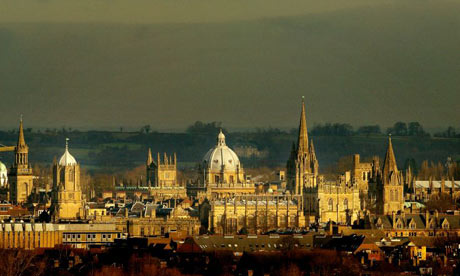
 
Oxford, where I was born - lovely city but I don't live there so why should I
vote there?

For Labour's Elaine Murray MSP to get involved in 'Let Wallace Vote' doesn't do her any favours. She had started supporting this campaign to extend the franchise for this one off occasion to include expats like James Wallace way back when her party were arguing that the electorate should not include 16 and 17 years olds because it should be the same franchise as votes in the Scottish parliamentary elections! They argued that any age extension should be for all elections. If this was Dr Murray's view personally as well then it would have made her downright hypocritical. Why argue for a one-off extension to include people, many of whom are probably well off, who don't live in Scotland getting to vote while arguing that 16 and 17 years olds, many of whom will be facing heavy competition in the jobs market, shouldn't enjoy the one-off extension to the franchise? How could that be fair?

See my point? All I can say to James Wallace is count your blessings, you have a well paid job down there in England, many of us here in Scotland are far less fortunate and we want to be able to vote for change. I know Mr Wallace cares about his own country and the issues his people face in their everyday lives but he should let them decide what's best for themselves. James Wallace has no obligation to replace his British citizenship with a Scottish citizenship, if he doesn't want the latter he can renounce it and just keep UK nationality status. So with the issue of citizenship eliminated this is a decision about how people are goverened in their everyday lives and that is not something that affects Mr Wallace directly any more than it does with the Holyrood elections. So Mr Wallace should not be allowed to vote on the 18th September referendum and if he wants to vote in Scotland he should first find somewhere to live in Scotland.

This referendum must be decided by the people whose everyday lives are in Scotland, the people living in Scotland.

Monday, 12 May 2014

A Service of Reconciliation?

I have to say it is a little patronising for the Church of Scotland to call their planned post-referendum service a 'service of reconciliation'. I understand such an idea would be needed in Northern Ireland although in a cross-denominational setting. But Scotland is not Northern Ireland. We'll disagree with each other verbally not violently and we'll all with maybe a few exceptions accept the result of the referendum and choose to get on with making the result work for the good of the country. We'll all, friends and foes, sit around the table at the pub together after the vote or if not a pub then we'll maybe all go for a nice little walk together in the countryside.

There is a place for the Church in this debate and a post-referendum service to bring politicians together in a single space. I'm not someone who thinks religion is just there to preach dogma. Although I disagree with the Church's stance against gay marriage I do feel the Church can do a lot to help people in their communities and could pass on some moral wisdom for the congregation. With politiicians the Church can be there saying, remember you are there to serve the people who elect you and you have to listen to their issues and their anger because that is your duty. For some politicians, especially those who are religious it is about finding moral courage and just having the time to pray to God and ask that that they, in that most difficult of occupations to get right, find the right answers, the right solutions to the problems and dilemmas they will inevitably face.

Personally, from my perspective what I would like to see in any event of 'reconciliation' is just for somebody to stand up in front of the mixed crowd of politicians and public figures and make the point loud and clear on behalf of Yes voters that the vote they cast in favour of independence was not necessarily to do with identity and wasn't a proclamation of 'Scottish-only'. Many of us voting Yes are NOT Scottish. We don't identify as such but we still believe in a Scotland governed by those elected by its residents. I want someone to stand up and shake this notion of non-solidarity with the people of England from the minds of those hardened unionists who really don't understand the desire for independence. Because I and many others are very angry at the idea that we are indifferent to the suffering of people south of the Border. We want to lead by example as people liberated from the shakles of Westminster. But unionist politicians should realise that if there is a No vote we are simply going to stand-by and sulk of course we will work with other people to get the best deal for Scotland and I hope that unionist politicians recognise that if there is to be a No vote, which I hope won't happen.

A church service at St Giles' on Sunday 21st September is a good idea. It just needs to be something that humbles politicians. It needs to be a place where Alex Salmond and Alistair Darling can shake hands without the same political heat of the debate and maybe even be a place for the two of them to discuss the season ahead for Hearts as they kick off their time in the second tier of Scottish football. Basically lets just make it a service which lightens the mood up. But don't call it a Service of Reconcilliation, it is the wrong term because we will be a nation already reconciled to the decision made three days earlier, we will respect it regardless of the result because this is a referendum where hopefully not a single bullet will have been fired.


St Giles' Cathedral

Monday, 28 April 2014

Birthday time

And so I can announce on +428 that at 4.28 on 4/28 (written regrettably the American way) my age was confirmed as the age I will be on referendum day, 29 years old. And that is the age I will be, at heart, for the next eight months or so. Because once the new year passes, I always give the age I will be on my forthcoming birthday. That's just how I am. None of this business of pretending to be a younger age. What's wrong with the age I am? Okay I am starting to put on more weight but about time because I've been a little too skinny. Not that that matters too much.

Age for me is the number of years that have passed since birth. I judge each age that comes to me accordingly and based on what goes on. After all you could have a miserable adolescence and be in prison at 18 but have turned your life round and be travelling the world at 50. So it isn't always better when your younger. There's no inherent thing other than the passing of time that makes somebody such an age, some people look older some people look younger. Just like there's not really a such thing as being homogenously Scottish or homogenously British. Each person is as different in what their national identity means or doesn't mean to them as zebras' stripes.

I like the age I am, I like the physical maturity that has comes with it and hopefully on the 18th September I will remember 29 as the age when I helped make Scotland an independent country. It's as though the whole of my twenties have been leading to this point, this political climax. I did after all start following Scottish politics only when I was 21. Independence for the country I've known since I was three will certainly feel like a long time coming.

For now though there is much work to be done and before that birthday presents to open.

Sunday, 6 April 2014

What if there's a No vote, then?

It is an unthinkable thought, the aftermath of a No vote. It is of course a likely outcome and that is why we are doing everything to campaign for a Yes vote. Indeed the need to bridge a gap is an extra incentive the Unionists just don't have. However, let me now offer my own approach to an outcome that favours a No vote.


First, there's the immediate aftermath of the No vote, the disappointment and deflation following so many months of hard campaigning but then the gracious acceptance that the people of Scotland have decided, albeit through listening to too much fear and scaremongering, to TRUST WESTMINSTER to deliver for them. This wouldn't be a vote to stay friends with England and Wales, our friendship and solidarity with people south of the border, especially with the working class, should be regarded as a given in any circumstance. There are many ways to help out people south of the border, the word charity comes to mind, but to give up our sovereignty in the hope that electing Labour MPs will be enough to bring a change of culture at Westminster would take some sacrifice. There has to be a very compelling financial case to stop people in Scotland deciding enough is enough we're taking control of our own affairs now. But a decision to be say No to independence, whatever the case, is a vote trust the UK political elite with important reserved issues. The moment I hear Johann Lamont declaring 'the people of Scotland have voted to remain British' is the moment I'll be fuming because for many of us being British is more about a simple belonging to a place that is called 'Britain', that is Great Britain. For many of us being British simply means being English, Scottish, Welsh or a mixture.

The principle of live debates: Chairman v. Chairman; Blairman v. Blairman

It goes without saying - counterparts should debate with one another in their rival visions. In the debate on Scottish independence this is no exception. The two Government leaders, each representing an opposite viewpoint, should debate with one another, Alex Salmond against David Cameron; the two chairs, Dennis Canavan and Alistair Darling as the two chairs should debate with each other; the two Blairs, Jenkins and McDougall who are both the managers of their respective campaigns should likewise share a stage; and then Nicola Sturgeon against Alistair Carmichael; Patrick Harvie against Johann Lamont; John Swinney against George Osborne; and so on. But we have a deadlock right now. Alistair Darling wants to debate with Alex Salmond but Alex Salmond doesn't, he wants instead to debate with David Cameron and David Cameron refuses to take part altogether. So someone has to give way or there will be no debates full stop.

Yet Salmond has offered a compromise: He is prepared to debate with Alistair Darling ONLY if he first gets the opportunity to debate with David Cameron. Well Alistair, there you have it. Your long desired chance to grill Alex Salmond in front of a live audience is within your reach. All YOU have to do now is write to David Cameron requesting that he debates with Alex Salmond and then you can get on with your debate. So what's stopping you?

Well, it's clear what's stopping Alistair Darling: a debate between Salmond and Cameron is a nightmare scenario for Better Together. It will look like Scotland versus posh Middle England, something that Ian Davidson admitted once in PMQs. There's actually no doubt about that and such a polarised perception would work to our advantage here in the Yes campaign. But behind it is a very simple principle: parity and accountability.


Well, that's two principles but anyway. If David Cameron is so keen to campaign for the Union, if the UK Government is busy investigating the effects of independence and if the Treasury wants to come up to Edinburgh to set up deliberate obstacles to indepdence then they are hardly behaving as impartial observers.  Indeed Cameron's excuse that it's a debate "between people living in Scotland" is blown straight out of the water by such interventions. Without wanting to go too much into the case of Abdel Basset Al-Megrahi in 2009, here at least was an example of the then Labour UK Government recognising this was a matter for the Scottish Government to get on with and therefore staying out of offering their own opinions on whether or not he should be released (that was left to the party in Holyrood). But on the subject of Scottish Independence, Downing Street clearly isn't an opinion-free zone.

David Cameron even managed a bit of instant hypocrisy in responding to the letter Alex Salmond sent requesting the debate. Cameron said:

"Alistair has been asked by all of the pro-UK parties in Scotland to lead the campaign for a No vote. It is entirely right for you to place yourself at the head of the Yes campaign, but not to decide who should lead for the No campaign, too."

Let's get this straight. In one breath he dictates that Salmond is leading the Yes campaign (when he isn't) but then he has the nerve to demand that Salmond doesn't dictate the leadership of the No campaign. In the first sentence he said that Alistair Darling is leading the campaign by the mutual agreement of 'all' the pro-Union parties. Presumably he meant all the Holyrood unionist parties. Well by that same logic let's get the SNP, Greens and three independent MSPs to agree the main champion for the Yes campaign: either Blair Jenkins or Dennis Canavan. I would recommend the latter as Dennis has a strong political background, is a fantastic speaker and would really make Alistair Darling feel uncomfortable. Also Canavan is Darling's direct opposite number as both are the chair's of their respective campaigns.

If Alistair Darling is adamant about debating with the person leading Yes Scotland he should at least have the decency and courtesy to write to campaign HQ in Hope Street to request they put forward their leader for a debate. But it isn't for Alistair Darling to decide who that leader is any more than it is for Willie Walsh of British Airways to decide who should be the CEO for Emirates or for Liverpool Manager Brendan Rogers to determine who should replace David Moyes over at rivals Man Utd. If Alistair Darling wants a leader-to-leader debate then it should be just that. But if it is about campaign leader challenging government leader in their constitutional viewpoint - Darling v. Salmond - then surely it is only right that that be balanced properly - Canavan v. Cameron. That thought would of course alarm Better Together a million times over but that's how it would have to work for the sake of parity.

If this referendum had been happening four years ago nobody would have objected to a debate between Alex Salmond and Gordon Brown. Yet everybody would have accepted that Brown was debating in his capacity as the head of the UK Government, the Prime Minister and not merely in his capacity as the highest profile unionist Scot. Cameron's presence in such a debate would be in the exact same capacity, as Prime Minister of the UK and the head of the government that, along with its parliament, is politically at the heart of the case for the Union. Just he doesn't live in Scotland (unless his retreat on Jura counts!).

David Cameron should be perfectly capable of speaking eloquently in defence of the Union he was after all educated at Eton. Not that I'm trying to claim private school education to be superior but Etonians are taught to be strong orators. David Cameron should also be suitably equipped to answer questions about the workings of Whitehall and about the current structures of the UK Government, it is him we expect to provide answers on such matters. If Alex Salmond is being expected to answer questions on independence as someone who will be heading one team of negotiators and upon whose shoulders the responsibilities of a nation lie then equally it is for the head of the opposite negotiating team to answer questions about how it would conduct proceedings following either outcome. We don't know who that would be post-May 2015 but we do know who it will be in October 2014: David Cameron. So as far as we know it's David Cameron.

If recent polls are anything to go by, the people of Scotland want such a debate to happen. So it is ironic that Alistair Darling should talk about it as Alex Salmond trying to create a distraction for the people of Scotland when it is exactly what they want. The people of Scotland want to ask both Salmond and Cameron the hard questions so they can make up their mind about which institution they should entrust their very sovereignty to. So by that very nature no back-bencher from the ruling benches let alone opposition party can comprehensively answer these questions.

Salmond has offered the prospect of being involved in two debates one with the Prime Minister and one with the leader of Better Together, therefore giving Alistair Darling, should he accept the offer, the possibility of having the last word. Yet he's refusing to accept that offer. Either he's not so desperate as he says he is for a debate or he can't stomach the thought of a debate between Salmond and Cameron in any circumstance. Yet how would he respond to a different offer, one where he was allowed to debate with Salmond on condition he first debates with Canavan? Surely he wouldn't refuse that arrangement, after all both debates are between two Scots both with a vote in the referendum, would he? Yet you can't help but feel that he would retort and say that Dennis Canavan isn't the true leader of the Yes campaigner and shouldn't debate with him. If that were to be Mr Darling's response it would only confirm his arrogance. In that instance he would be behaving like a spoilt child who wants to eat his cake and still have it! He therefore does not deserve the debate he wants.

My suspicion therefore is that no live debates will take place at all involving Alex Salmond, Alistair Darling or David Cameron. But the invitations will likely remain symbolic in the run-up to the referendum being for debates that didn't happen but should have. Maybe then the stage should be set up any way with Yes on one lectern and the logo for the Scottish Government and better together on the other lectern with the logo for the UK Government with the invitations sent out to the heads of the two governments. That way, with Alex Salmond likely to take to the stage, David Cameron has little choice but to either turn up in person or send a Scottish representative from his cabinet a move which would mark out his weakness as a leader. So I will leave you with two pictures with which to illustrate this idea.


Saturday, 5 April 2014

Irreplaceable Margo, 1943-2014

Today I was supposed to be using this post to mark five months since the passing of Nelson Mandela, a year since the passing of my pet cat Cherry and twenty years since the untimely death of Kurt Cobain. But a day ago Scotland lost one of its finest political talents, Margo MacDonald and so it would be more fitting to remember someone who will be enormously missed at such an important time in our nation's history.

In the Scots Independent shortly after the SNP's historical victory in 2011 the results were shown with the names of the parties abbreviated. And there alongside SNP, Lab, Con, Green and Lib Dem was the name Margo. Not Independent or Ind or Margo Macdonald but quite simply Margo. As Alex Salmond said yesterday in tribute to a woman who stood out from all the others "Very few politicians are recognised and known to the public by their first name - Margo was."


For all independence campaigners she was the person who by winning the 1973 by-election in Govan helped change the perception of Scottish nationalism from being all about beardy men obsessed with the past to being about a genuine concern for social welfare in some of the poorest parts of the country. She had a way of winning arguments because she could hold her ground with great conviction and immense humour.

I first heard of Margo MacDonald some 7 or 8 years ago when I first took a real interest in Scottish politics and I read that the one independent member of the Scottish Parliament, Margo,
 was also a supporter of independence. It was therefore convenient to see that the banner of Independent was so apt. She was clearly an independent-minded independence supporter and like her husband, the equally formidable Jim Sillars, she did not share the views held by the SNP regarding many aspects of an independent Scotland like the currency and EU membership. She was widely respected across the political classes and she often made her voice heard in parliament as interventions to great effect. In First Minister's questions that usually came as a point of order at the end of the session and the other members would pause to listen. Because of the person she was it was easy to take notice of the issues to which she was drawing our attention. In that regard alone she could be seen as the mother figure of the parliament.


Of course Margo MacDonald will be remembered in recent years as a champion of causes that other politicians were too shy to confront notably assisted dying and the rights of sex workers in Edinburgh. Assisted dying was an important issue to Margo because of her Parkinson's and so she published a Private Members Bill to introduce it in Scotland. On this issue I do lean in favour of assisted dying but still haven't made my mind up as there are issues surrounding the possible consequences of such a law. But it is good nonetheless that members were given a free vote by their parties so they could make up their own mind. All credit to Margo for using the opportunity of Scotland's devolution to hold this debate.

But she won't live to see the outcome of the reintroduction of this bill nor the other thing she had dreamed of seeing her whole political life, the Scottish independence referendum. We can all take inspiration from the manner in which she participated in the debates about Scotland's future. I therefore will share with you a video of Margo alongside three other women in a BBC debate back in June 2012:


I am very saddened that Margo MacDonald has passed away and that she will not be with us to shape the early years of an independent Scotland. She is completely irreplaceable and it will be many years before we see her likes again but in her spirit we can carry out her vision of a socially just and confident nation that will come with Scottish independence.

My thoughts are with her husband Jim, her daughters Zoe and Petra and all of her family at this sad time.

Monday, 31 March 2014

Week 13, Unlucky for some

Who would have known it? In just one week, Week 13 of 2014 (let's call it 13'14, that has a certain ring to it!), everything changed, the tide turned, a new order was born, and you can think of any other number of clichés to describe it. But basically in the course of the week the media in Scotland was dominated by a truth it couldn't avoid. That now the gap in the polls was narrowing and the alternative media and twitter's cybernats were finding a stronger voice, the Yes campaign was suddenly becoming a force to be taken seriously. And so it took only a few gaffes in the Better Together hierarchy and an underwhelming performance by Nick Clegg at the Lib Dems' Scottish conference to embarrass the Unionists to the point of admitting the Yes campaign could win this September.


The ball started to roll for the Unionist campaign a week ago on Sunday as new polling revealed the extent to which people were starting to turn away from No and give their backing to Yes. But that was only the beginning.