Yet again a long time has passed since my last blog update. I should first take the opportunity to express my sadness at the loss of Charles Kennedy. We ought to remember that at the end of the day politicians are human beings like us and life after the end of a remarkable career isn't always going to be easy to adjust to. Yet Charlie had a life beyond Westminster to look forward to and when it came to arguing for the UK to remain in the EU, he would have been there a formidable debater taking our country, maybe even finding more time to lead the Yes to EU campaign. We'll never know.
There was a time before I properly followed Scottish politics, when UK-wide politics was higher on my radar. That was 2006 and earlier when Charles Kennedy was leading the Liberal Democrats at the height of their popularity and when I would have voted for them in Westminster elections. Under his leadership they represented the voice of progress, the party I really wanted in Government and it was because Charlie broke ranks with his own party to argue against the Iraq War that it seems he won over so many fans. When news broke that he resigned as leader in 2006, coincidentally as I remember on the same day the Observer started to resemble a tabloid, I felt very disappointed. When I would next get to vote for the Lib Dems Kennedy would no longer be in charge. Needless to say though, it was the SNP I voted for at my next opportunity. But I continued to feel that through Charlie's warmth a sense that this was a politician who was a real people's man. During the referendum campaign, I felt sure that Charles' voice was the one that stood out from the scaremongers quietly arguing positively for Scotland to remain part of the UK. But it seemed drowned out though by cacophony of Project Fear.
He was a proud Scot but more specifically he was a proud Highlander. Charles Kennedy will be missed by everyone and Scottish and UK politics is all the poorer for him not being here. My thoughts remain with his family and friends.
On the subject of electoral reform, the Conservative majority despite being the minority of the popular vote makes the case for electoral reform unanswerable. Except from the Tories point-of-view of course. Even Nicola Sturgeon, who benefitted by 95 percent of Scottish MPs being won by only 50 percent of the popular vote for the SNP, remains committed to the case for electoral reform. However, there's another elephant in the room, the House of Lords, and it could be argued that this is what should be sorted first because the second chamber is the difference between legislation being passed and it being rejected.
I have been in favour of a proportional system for the House of Commons through the use of the de Hondt method. But it is hard to see how such a system would work without either increasing the number of seats to accommodate additional list members or increasing the size of the constituencies so fewer constituency members are elected to allow space for the additional members. Of course we could use the PR system used for European elections but that means we could only really have regional MPs and fear with that is that a bigger constituency for members means the fear certain local issues would end being sidelined in parliament for 'more important' regional ones. And importantly people value the element of direct local accountability in a size of constituency where their voice is most likely to be heard in front of the Government in the House of Commons.
Far better in my opinion is to sort out the chamber which acts as the last line of defence against unpopular government policies, the upper house, currently the House of Lords. If you have a fully proportional composition of members in this chamber then ultimately legislation that the majority of people in the country didn't vote for doesn't get passed because that majority is properly represented.
It normally follows that the party with the largest share of the popular vote ends up with the most seats because usually the majority of constituencies each represent the country as a whole at a miniature level - the average constituency if you like. It makes sense democratically that the party with the most seats in the Commons gets the first opportunity to form a government, but it would only be able to form a government if it can get a Queen's Speech past both houses. Then it doesn't matter too much that there's not a proportional representation in the lower house if that's the price for direct local representation. The point with a revising chamber is that it is just that - a place for revising legislation. Yes the government has had more or less its own way in the lower chamber but now it's time to test that against the assumed opinion of the country as a whole. I say 'assumed opinion' because its assumed that the opinion of the party represents the opinion of the people that elect them if they are following through on their manifesto pledges.
If such a second chamber, lets call it a senate, is fully proportional and elected properly at the same interval as in the general election it would be a more respectable component of our legislature. And the members, the senators, would be more acutely aware of their responsibilities and the accountability at which they are held. When they turn up to work they actually have to get some work done and if you have them up for reelection every two years like in America then they really have no time to sit on their butts. The Government would have to regularly make sure that whatever laws they are trying to craft they have to be sure they can command the majority of the both houses.
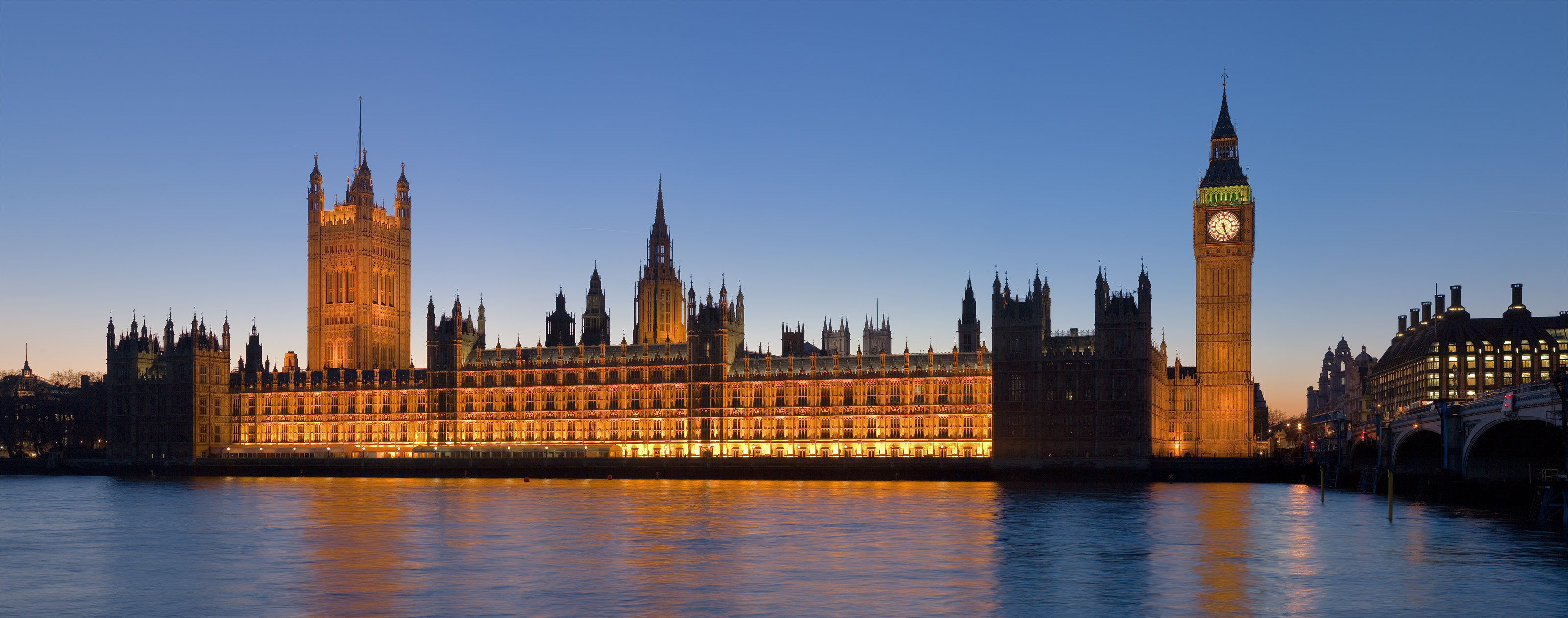
One thing's for sure. The new intake of Peers announced in the dissolution honours list a few days ago taking the total to well over 800 makes a real mockery of democracy with these people having either stood down at the last election or been voted out by the public. And 826 is too many. Lets bring that number down to a size that can actually all fit onto the seats at the same time (without allowing any spaces for them lie down and doze!)
Sunday, 30 August 2015
Monday, 30 March 2015
Why we cannot vote Labour after what they did in the referendum
I know this is my first post of the 2015 and in fact the first one since the end of September, a month we'll never forget.
I've been absent from here because I don't know what I can add that hasn't already been said by one of the many other people who campaigned for a Yes vote. In the weeks after the referendum I couldn't help feeling that a huge step had been taken backwards and now our goal was as far away as it was back before the election of 2007 when the SNP were only just seeking to enter their first term in office. A lot has changed since then but it will be just as many years if not more before the next independence referendum comes upon us.
However, there must still be a purpose for everyone who became engaged and energised by last September's campaign. There has to still be something we have worth fighting for. Well we do. There is a General Election coming up in less than forty days time and for the first time ever it is conceivable that the SNP could have a real influence on Westminster politics.
Of course the naysayers will as usual tell us that it is unthinkable that a party 'wants to run the very thing it wants to break up'. Which leads us to ask the question why did they want us to stay so badly in a 'family of 'equal' nations'? We were told Scotland brings added value to the UK that it brings something special to Westminster politics. Yet now it's looking like they don't want us to make a contribution to Westminster politics if we decide we want the SNP to represent us. It's clear there's no love lost.
But what is also clear is just how much Labour has alienated the Scottish population over the last four or five years. It seems like only yesterday that it was April 2010 when Labour could still happily claim Scotland as their own territory, that tactical voting to keep the Tories out seemed justified. Not this time though. Labour's current mantra - "vote SNP get Tory" - is no longer convincing. And it's ironic because what are Labour now but, well, the Red Tories. If Labour so badly wanted Scotland to banish the Tories we had that golden opportunity to make it so and make it permanent last September!
But my dislike of the Scottish Labour Party is far deeper than that. They just didn't respect the ordinary people who voted Yes. They couldn't appreciate the real concerns that motivated us to aspire to a different Scotland through a Yes vote. And whilst presenting erratic counter-arguments they stood shoulder-to-shoulder with the Tories and the Lib Dems to try and unfairly blacken our name. So folks don't vote Labour. Vote SNP. And do it for these reasons:
And if unfortunately the Tories do emerge with the most seats then my message to Labour is clear:
Don't blame us, the people of Scotland, for your party's misfortunes. We only voted for the party we wanted to have fighting our corner, the party we felt represented us. If you can't win more seats than the Tories then look at yourselves not us. It can only be your fault, Labour, if you don't make enough effort to win over the hearts and minds of voters in the places where you're actually fighting the Tories. We accept no responsibility for Ed Miliband's ineptitude and if you walk away from any post-election talks of an anti-Tory alliance simply because you've lost then that is your problem. You will be the ones in the end letting the Tories in through the back door.
Game on!
I've been absent from here because I don't know what I can add that hasn't already been said by one of the many other people who campaigned for a Yes vote. In the weeks after the referendum I couldn't help feeling that a huge step had been taken backwards and now our goal was as far away as it was back before the election of 2007 when the SNP were only just seeking to enter their first term in office. A lot has changed since then but it will be just as many years if not more before the next independence referendum comes upon us.
However, there must still be a purpose for everyone who became engaged and energised by last September's campaign. There has to still be something we have worth fighting for. Well we do. There is a General Election coming up in less than forty days time and for the first time ever it is conceivable that the SNP could have a real influence on Westminster politics.
Of course the naysayers will as usual tell us that it is unthinkable that a party 'wants to run the very thing it wants to break up'. Which leads us to ask the question why did they want us to stay so badly in a 'family of 'equal' nations'? We were told Scotland brings added value to the UK that it brings something special to Westminster politics. Yet now it's looking like they don't want us to make a contribution to Westminster politics if we decide we want the SNP to represent us. It's clear there's no love lost.
But what is also clear is just how much Labour has alienated the Scottish population over the last four or five years. It seems like only yesterday that it was April 2010 when Labour could still happily claim Scotland as their own territory, that tactical voting to keep the Tories out seemed justified. Not this time though. Labour's current mantra - "vote SNP get Tory" - is no longer convincing. And it's ironic because what are Labour now but, well, the Red Tories. If Labour so badly wanted Scotland to banish the Tories we had that golden opportunity to make it so and make it permanent last September!
But my dislike of the Scottish Labour Party is far deeper than that. They just didn't respect the ordinary people who voted Yes. They couldn't appreciate the real concerns that motivated us to aspire to a different Scotland through a Yes vote. And whilst presenting erratic counter-arguments they stood shoulder-to-shoulder with the Tories and the Lib Dems to try and unfairly blacken our name. So folks don't vote Labour. Vote SNP. And do it for these reasons:
- This is justice. Disputing our case for independence is one thing - trying to smear us quite another. Remember how all these Labour politicians tried to suggest we were all abusive cybernats? Okay maybe I'm exaggerating a bit but when a small number of abusive online activists attacked No voters it was all that was needed for Labour, Lib Dem and Tory politicians. They simply couldn't resist using the situation against the rest of us who were NOT responsible for what got said by those so called 'cybernats'. And yet they turned a blind eye to all the occasions when some of their own supporters metted out similar abuse against people who were voting Yes. I agree online abuse is wrong whichever way it comes from. But if you're going to condemn it you condemn BOTH sides and not just one side in order to try and bolster your side. The SNP went out of their way to condemn abuse on both sides but Labour tried to make it sound like a problem exclusive to Yes supporters. I am still to this day seething with fury over Labour's attitude on this matter, it was one of the biggest injustices of the whole campaign and just on that I will not forgive them! I accept the referendum result quite willingly even if it is not what I wanted as I accept people voted No in good faith. But I will struggle to come to terms with Labour tarring us all with the same brush. Of course I am equally annoyed with the Tories and Lib Dems but I reserve my biggest anger for Labour, the party who is feebly trying to win back Yes voters without so much as an apology.
- Additionally lest we forget how Jim Murphy's predecessor, Johann Lamont, tried to call our cause 'a virus'. You're hoping to be the next first minister and you effectively call a third of your own compatriots a virus? Is this the woman we were supposed to look up to? And then Jim Murphy himself using his Irn Bru crate tour of Scotland to call us 'nosiy nationalists' - now he's trying to reach out to us. It's laughable.
- Labour stood with the Tories to campaign in Better Together. They could easily have run the campaign without them but instead they invited them to take part. The result? A common message based on an anti-SNP theme. They may have won the referendum but the path they trod to try and maximise support will soon backfire on the party.
- When it comes to policies Labour are little better than the Tories anyway. To have given the Tories support for the UK austerity programme means they have endorsed cuts in their desperation to overturn the deficit. The consequence will likely be more unemployment and more of our vital frontline services at risk. For what? Some sort of better economic outlook one day in the distant future? They must realise that when some of their own MPs including Dianne Abbott and Katy Clark (an Ayrshire MP) rebelled something is a miss in this programme. The SNP on the other hand voted with their conscience alongside Plaid Cymru and the Greens to join the few brave Labour souls. The bill was passed with fewer MPs voting against than years I've been alive and I'm still a young man!
- Voting SNP means Scotland getting a far better voice fighting our corner in Westminster. Simple.
- It may actually be a blessing in disguise for Labour if they face annihilation in Scotland to the SNP. If they are to stand any hope of getting more MPs than the Tories they will have to win in England. Which means taking more centre ground possibly more than they would prefer. And then at least they could be willing to scrap some of their more regressive policies to get the votes of the SNP and treat it as a concession they had to make. I don't think the SNP will particularly mind taking the 'blame' for scrapping Trident.
- Contrary to Labour's arguments that the party that wins the most seats has the exclusive right to seek to form the next government, it is all dependant on whether or not the party with first priority (granted that's the party with the most seats) can get the first Queen's Speech passed. The party with the most MPs elected may feel cheated by a deal between two smaller parties but if the collected weight of their shared policies is good enough for parliament it's good enough for forming a government. There's a small chance Labour will win more seats than the Tories but if they don't they can be assured there'll be a good majority against Tory policy. Ed Miliband being Prime Minister is not a thought to savour. But if the SNP MPs we send to Westminster have enough influence then Miliband would only be occupying the floor of Number 10 while dancing to our tune! He may have ruled out a formal coalition with the SNP but if Ed Miliband is serious about gaining the keys to Britain's most coveted front-door an informal agreement with the SNP will be almost if not entirely unavoidable.
And if unfortunately the Tories do emerge with the most seats then my message to Labour is clear:
Don't blame us, the people of Scotland, for your party's misfortunes. We only voted for the party we wanted to have fighting our corner, the party we felt represented us. If you can't win more seats than the Tories then look at yourselves not us. It can only be your fault, Labour, if you don't make enough effort to win over the hearts and minds of voters in the places where you're actually fighting the Tories. We accept no responsibility for Ed Miliband's ineptitude and if you walk away from any post-election talks of an anti-Tory alliance simply because you've lost then that is your problem. You will be the ones in the end letting the Tories in through the back door.
Game on!
Monday, 29 September 2014
Scotland's referendum: what went right, what went wrong and how we will win it next time
What a long, long month September 2014 has been - and yet we still have a couple of days of it left! During this time I have been to two job interviews, been given one job, had to give it up to start the other and of course been as fully involved in the last two weeks of campaigning including one trip to a border tea party in Berwick as well as helping out at street stalls and then back to Newton Stewart for the big vote itself. Followed by great disappointment but then the renewed determination of the great defeated. It has been a dramatic, highly charged few weeks.
We came very close to winning a Yes vote in the independence referendum with 45%. Only another 200,000 of the swing voters who eventually went for a No vote could have been enough to win it for the Yes campaign albeit by a very slim majority. In the most deprived areas of Scotland we achieved our highest vote - Glasgow, Dundee, West Dunbartonshire and North Lanarkshire. This could only have been testament to the great work put in by the Radical Independence Campaign which made sure people realised this was a huge opportunity for change. But I believe that threats made by big banks and businesses, threats they didn't need to make and threats given extensive coverage by the mainstream media lost it for us.
However dejected we feel about the result, the fact that the Yes campaign grew support for independence substantially is a huge achievement. We were always the underdogs, yet in Glasgow we polled in a majority of those who turned out to vote. I will always feel proud of Glasgow for that support despite the Daily Record being so against independence. The ball is now firmly in Westminster's court, they have to deliver or face a loss in support for the Union - and the politicians down there clearly realise that. As the 45% we can help make sure they are fully held to account for what they do and don't deliver in the way of enhanced devolution.
It is hard to say if we made any mistakes in our campaigning, we could only really do our best but we certainly proved we were capable of doing our best. I think next time we will definitely need a bolder vision of independence because on certain issues we were ridiculed for not going all out in a break from the UK. Most notably was the question of currency. The SNP's preferred option of keeping the Pound Sterling put us at the mercy of Westminster who could and did say no to a currency union. And the Unionist politicians were able to use to Pound as a pawn in the argument in such a way that it was as though Scotland needed the English balance of payments into the Pound rather than the other way round. If England, Wales and Northern Ireland didn't sign up to a currency Union they would lose a important contrituion to their own currency by Scotland not being part of it and then they would have to pay all of the UK debt because they are legally responsible for it. In other words it would be the rUK, rather than Scotland, that loses out as a consequence of no currency union taking place. The pound would weaken without oil and other exports being a part of the economy. A separate Scottish currency would certainly be a strong currency as Jim Sillars has pointed out. So my view is that next time, we go the whole way and argue that an independent Scotland should use its own currency. This would put Scotland in a far better negotiating position at a future independence negotiations with Westminster.
I also think we made a few other mistakes in our arguments mostly where we were seemingly trying to soften the blow of independence. One of them was the idea that 'we're not really leaving the United Kingdom, because we'll still be part of a united kingdom with the Queen as head of state.' I don't think this was a very wise argument. The United Kingdom is a clear concept that refers to a particular sovereign state as governed currently from Westminster rather than all the countries with the Queen as head of state. Otherwise we might as well regard Australia, Canada and New Zealand as 'part of the UK.' If people say they 'like the idea of being part of the UK' then we have to challenge why they like it and why they wish to be part of the UK when it is as it is a state that doesn't work for everyone. For many of them its simply personal, a sort of nationalism, so we can't really do anything about that. But if they say 'we like Scotland being British' you have to challenge them as to what they mean by 'being British'. Why do we need to share a common sovereign state to feel like our fellow citizens and family south of the border are still very much are fellow citizens and family? And why should British only be the adjective for the UK when it is also thought by many to simply be the adjective of a place called Britain regardless of whether that's the UK or Great Britain. It's just those two definitions become unpegged with Scottish independence. I should say however that being British 'because we're part of the British Isles' is not a very good argument either because the name British Isles is contentious in the Republic of Ireland where there is no basis either political (UK) or geographical (Great Britain) for being considered British. I for one believe 'the Anglo-Celtic Isles' would be a better name for these isles where it lacks a rather imperialist set of connotations and seems more appreciative of different cultures within the isles.
Similarly I think we should have been willing to accept Scotland as a secessionist country rather than a co-continuation of the UK. I can understand the co-continuation argument but I think it reasonable for people in England, Wales and Northern Ireland to feel that their own countries would form the outright continuation the UK in the eyes of the international community. The principle of co-continuation would mean we automatically remained part of the EU instead of having to reapply. But soon that principle could be unnecessary as the UK leaves the EU and so in any circumstance Scotland would have to reapply. We should be able to wholeheartedly embrace the idea of a new sovereign state emerge with an institutional blank canvas to paint up our own new internationalist society. Let South Britain and Northern Ireland be the continuation of the UK, we have our own agenda up here. UK is not OK.
It has been the most fantastic and unexpected response from 45% who didn't win that the SNP has suddenly enjoyed a sharp rise in membership numbers with people turning to Alex Salmond and Nicola Sturgeon's party from often socialist backgrounds. This gives the SNP fresh blood that could help move the party in a direction towards a more radical vision of independence. I certainly hope that very soon we could see a revote on NATO which would overturn the prospect of joining such a controversial organisation. A reenergised SNP should also see a discussion had between radicals and moderates in the party about the what approach to taxation is the best to ensure Scotland is both a successful economy and a progressive society. Add to that the promise of a referendum on the monarchy and the thought of entering the European Union as our own state independent of a country that will probably be leaving it in 2017 and you have a very attractive vision of a new radical independent Scotland.
We came very close to winning a Yes vote in the independence referendum with 45%. Only another 200,000 of the swing voters who eventually went for a No vote could have been enough to win it for the Yes campaign albeit by a very slim majority. In the most deprived areas of Scotland we achieved our highest vote - Glasgow, Dundee, West Dunbartonshire and North Lanarkshire. This could only have been testament to the great work put in by the Radical Independence Campaign which made sure people realised this was a huge opportunity for change. But I believe that threats made by big banks and businesses, threats they didn't need to make and threats given extensive coverage by the mainstream media lost it for us.
However dejected we feel about the result, the fact that the Yes campaign grew support for independence substantially is a huge achievement. We were always the underdogs, yet in Glasgow we polled in a majority of those who turned out to vote. I will always feel proud of Glasgow for that support despite the Daily Record being so against independence. The ball is now firmly in Westminster's court, they have to deliver or face a loss in support for the Union - and the politicians down there clearly realise that. As the 45% we can help make sure they are fully held to account for what they do and don't deliver in the way of enhanced devolution.
It is hard to say if we made any mistakes in our campaigning, we could only really do our best but we certainly proved we were capable of doing our best. I think next time we will definitely need a bolder vision of independence because on certain issues we were ridiculed for not going all out in a break from the UK. Most notably was the question of currency. The SNP's preferred option of keeping the Pound Sterling put us at the mercy of Westminster who could and did say no to a currency union. And the Unionist politicians were able to use to Pound as a pawn in the argument in such a way that it was as though Scotland needed the English balance of payments into the Pound rather than the other way round. If England, Wales and Northern Ireland didn't sign up to a currency Union they would lose a important contrituion to their own currency by Scotland not being part of it and then they would have to pay all of the UK debt because they are legally responsible for it. In other words it would be the rUK, rather than Scotland, that loses out as a consequence of no currency union taking place. The pound would weaken without oil and other exports being a part of the economy. A separate Scottish currency would certainly be a strong currency as Jim Sillars has pointed out. So my view is that next time, we go the whole way and argue that an independent Scotland should use its own currency. This would put Scotland in a far better negotiating position at a future independence negotiations with Westminster.
I also think we made a few other mistakes in our arguments mostly where we were seemingly trying to soften the blow of independence. One of them was the idea that 'we're not really leaving the United Kingdom, because we'll still be part of a united kingdom with the Queen as head of state.' I don't think this was a very wise argument. The United Kingdom is a clear concept that refers to a particular sovereign state as governed currently from Westminster rather than all the countries with the Queen as head of state. Otherwise we might as well regard Australia, Canada and New Zealand as 'part of the UK.' If people say they 'like the idea of being part of the UK' then we have to challenge why they like it and why they wish to be part of the UK when it is as it is a state that doesn't work for everyone. For many of them its simply personal, a sort of nationalism, so we can't really do anything about that. But if they say 'we like Scotland being British' you have to challenge them as to what they mean by 'being British'. Why do we need to share a common sovereign state to feel like our fellow citizens and family south of the border are still very much are fellow citizens and family? And why should British only be the adjective for the UK when it is also thought by many to simply be the adjective of a place called Britain regardless of whether that's the UK or Great Britain. It's just those two definitions become unpegged with Scottish independence. I should say however that being British 'because we're part of the British Isles' is not a very good argument either because the name British Isles is contentious in the Republic of Ireland where there is no basis either political (UK) or geographical (Great Britain) for being considered British. I for one believe 'the Anglo-Celtic Isles' would be a better name for these isles where it lacks a rather imperialist set of connotations and seems more appreciative of different cultures within the isles.
Similarly I think we should have been willing to accept Scotland as a secessionist country rather than a co-continuation of the UK. I can understand the co-continuation argument but I think it reasonable for people in England, Wales and Northern Ireland to feel that their own countries would form the outright continuation the UK in the eyes of the international community. The principle of co-continuation would mean we automatically remained part of the EU instead of having to reapply. But soon that principle could be unnecessary as the UK leaves the EU and so in any circumstance Scotland would have to reapply. We should be able to wholeheartedly embrace the idea of a new sovereign state emerge with an institutional blank canvas to paint up our own new internationalist society. Let South Britain and Northern Ireland be the continuation of the UK, we have our own agenda up here. UK is not OK.
It has been the most fantastic and unexpected response from 45% who didn't win that the SNP has suddenly enjoyed a sharp rise in membership numbers with people turning to Alex Salmond and Nicola Sturgeon's party from often socialist backgrounds. This gives the SNP fresh blood that could help move the party in a direction towards a more radical vision of independence. I certainly hope that very soon we could see a revote on NATO which would overturn the prospect of joining such a controversial organisation. A reenergised SNP should also see a discussion had between radicals and moderates in the party about the what approach to taxation is the best to ensure Scotland is both a successful economy and a progressive society. Add to that the promise of a referendum on the monarchy and the thought of entering the European Union as our own state independent of a country that will probably be leaving it in 2017 and you have a very attractive vision of a new radical independent Scotland.
Saturday, 6 September 2014
The important difference between ethnicity, national identity, citizenship, residency and where you're born
For many people, it's nice and simple. You're born in a single country and in that same country, specifically the same region as your birth, you grew up, were educated and still live. Both your parents were born and grew up there as did many of their preceding generations. You therefore have the local accent and of course the citizenship of that country. You are quite unmistakably of that country specifically of that region.
But for many of us it really isn't as simple. Yours truly is a case in point. I was born in Oxford to an English mother and Norwegian father (whose father was Swedish). I grew up in a corner of southern Scotland called Galloway from the age of three, though spent some of my formative years in Penrith and the Eden Valley. That said my accent was the one my Mum and older siblings spoke, a southern English accent. I suppose that was awkward because everyone else in my class at Primary School had the local Scottish accent and even at school in the north of England my accent stood out no less. In relation to my father's side of the family, we regularly went on our summer holidays to Scandinavia to our cottage in Sweden where we saw all of my father's family and that helped reinforce my sense of being part Scandinavian.
I'm not Scottish. I do not consider myself to be Scottish. I still live in Scotland but what I am in terms of national identity is quite different to where I call my home. Because national identity is an aspect of personal description while my home is a matter of location and where I feel I belong. So while my home is Scotland, I am English. My national identity relates to my parents' backgrounds and I have identified one of those backgrounds as my primary nationality, the one I give if I can only state one or only feel like stating one. That primary nationality is for me determined through a stronger sense of association with that background than the other. If I had grown up anywhere in Scandinavia speaking their language I probably would have given my identity as Norwegian so in some respects my upbringing does determine my primary nationality in terms of choosing between English and Norwegian. But I grew up on the west side of the North Sea speaking English as a first and only fluent language meaning I felt more English than Norwegian. So ironically I'm English because I grew up in Scotland. Strange isn't it?
I don't particularly like the word 'national identity' used for individual people. It's supposed to be a collective thing - the national identity of Scotland is about an overall image and character of a nation. But people within any nation are highly diverse culturally and you can get someone born and bred in Edinburgh who has more in common socially and culturally with somebody from Auckland, New Zealand than someone living just next door. When I say "my national identity is English", it is merely a statement of my association with the country of England than me being a microcosm of the English national character, whatever that might be. Still the term 'national identity' is a word used on individual basis' so I guess I will have to use it. So my national identity is English. Or to be more precise I am English first. Then I am Norwegian and then I am Swedish. And distantly I am equally Scottish and Irish but I have little knowledge of the ancestors they refer to so I don't really feel they're part of my national identity.
This is why I objected to one particular Unionist complaint. When a couple of years ago they started going on about a supposed false choice between Scottish and British I did a bit of google research to investigate the origin of the complaint. Blow me - the offending question about ethnicity drafted in 2008 for the Scottish Government's 2011 census. The multiple choices included Scottish, English, Welsh, Irish, British and so on and you could only choose one. You also had an 'Other' box with a space to write in the term you use to describe your ethnicity. The cause of offence was that if you stated Scottish you were saying you were not British. But this was to misunderstand the question. It asked you which best describes you ethnicity. Not your national identity but your ethnicity. Many people who are Scottish in all lines going back several generations would have chosen 'Scottish' because they don't know of any other ethnicities in their background but people who tick British do so usually because a number of their family lines are also ethnically English, Welsh, Irish or a mixture so the word British is used as a means of combining them all. The reaction from the unionists seemed to suggest people should have be an additional 'Scottish and British choice'. For one thing this would betray many people's feeling that to say you're Scottish is to actually say you're British. A lot of people in England feel that stating you're 'English' is stating you're 'British' because quite simply England is a nation of Britain. Likewise with Scotland. The suggestion was that people on either side on the constitutional divide are somehow divided by ethnicity. Such a suggestion would be both unwise and absurd because ethnicity is nothing to do with political preferences. Lets just for argument's sake take the Proclaimer twins. Imagine Craig Reid converted to being pro-union while Charlie Reid stayed firmly in the pro-independence camp. Does Craig Reid suddenly have a different ethnic background to the very person with whom he shared the same zygote? I think not.
Now for nationality, the official kind, that is to say citizenship. Yes in case you haven't realised there's a difference between nationality and nationality. Two definitions of nationality, one being official (citizenship), the other being unofficial (national identity) and often based on the subjective. I would gladly take up Scottish citizenship but that wouldn't make me Scottish by the concept of national identity that I explored in an earlier paragraph. My national backgrounds would continue to be English, Norwegian and Swedish. But I would now be a citizen of the Scottish state and so would be officially saying I have trust in that state to look after me. It will be a much more notable statement when, despite being allowed to keep British citizenship in duality with Scottish citizenship, I renounce British citizenship in favour of just Scottish citizenship. I haven't yet decided if I'll actually do that but I'll think about it. But I can tell you that despite all my pride in my Norwegian heritage I'm absolutely glad I never held Norwegian citizenship. If I had done so I would have been required to do national service at the age of 18. No way would I have wanted that! So for me citizenship is about the sovereign state to which I choose to belong and be protected by.
Residency is about where I live and is an unofficial kind of citizenship. Because there is no such thing currently as Scottish citizenship the franchise of a referendum in Scotland can only pragmatically be determined as the people living there and therefore making the most directly contribution to the Scottish economy and Scottish society. So a Scottish resident may or may not be Scottish by origins or self-identification but he or she is considered one of the Scottish people when it comes to determining Scotland's future.
Where you're born? That's surely the easiest thing to understand. But the country of your birth could be anywhere, you could be born when your parents are on holiday abroad for example. Many people feel a certain bond with the country of their birth regardless of its relevance or irrelevance to their parents' national backgrounds. If I had been born in say, Yemen, I may have been tempted to have describe myself as Yemeni for the novelty factor. Incidentally someone who was born in Yemen was Eddie Izzard although he would generally describe himself as English. Still I think many people would make a case for the entitlement to citizenship of the country of your birth if you choose since it is listed on your own passport and birth certificate and if you're born in 'Yemen' you're 'born Yemeni'. Fortunately for me I don't have that confusion, I was born in England so my primary nationality is also my birth nationality.
As for the question 'Where do you come from?' for me that is a bit ambiguous. Are they asking me my nationality (national identity) or my country of residence? Well if I'm being asked that question in my country of residence, Scotland, I would usually say something, South-west Scotland, Dumfries and Galloway or Newton Stewart, depending on how well they might know the places around Scotland. However, they may enquire further about my accent so I would mention that my family are from Oxford originally. If I'm somewhere abroad, like Italy, India or somewhere else where they're quite chatty and I'm asked the question of where I come from then my simple answer would be 'Scotland'. What they're interested in knowing is the country where I live for most of the year, the country which was the starting point of my journey to that destination where I'm talking to these very friendly people. They want to know about where you live because that's the place you know the best, that's your home. If however I'm being asked what my nationality is, well that's different, then I say 'I'm English' because they're asking me about my national description not about where I live. But normally the people I get talking to ask me where I come from so that's okay.
So there you have it - the difference between birth, ethnicity, nationality and so on. They are all different ideas, each with their own meaning. And for people like me their descriptions are hugely mixed up but the more I explore them the more I understand what's what. Is there anything in there that's a source of pride for me? Not really. Except for my Scandinavian heritage because that means I've had somewhere truly wonderful to visit during Summer holidays. And I also like the fact that my English Great-Grandfather drove the Flying Scotsman (though only from London to York). I feel privileged to have lived in Scotland most of my life and now I feel a I have a massive chance to help shape that nation's future and determine the sort of place it becomes. But different aspects of my personal description I treat as individual subjects which may or may not be relevant to a debate about a country of 5.3 million people and therefore 5.3 million different identities.
But for many of us it really isn't as simple. Yours truly is a case in point. I was born in Oxford to an English mother and Norwegian father (whose father was Swedish). I grew up in a corner of southern Scotland called Galloway from the age of three, though spent some of my formative years in Penrith and the Eden Valley. That said my accent was the one my Mum and older siblings spoke, a southern English accent. I suppose that was awkward because everyone else in my class at Primary School had the local Scottish accent and even at school in the north of England my accent stood out no less. In relation to my father's side of the family, we regularly went on our summer holidays to Scandinavia to our cottage in Sweden where we saw all of my father's family and that helped reinforce my sense of being part Scandinavian.
A cottage in Sweden reminiscent of summer holidays
I'm not Scottish. I do not consider myself to be Scottish. I still live in Scotland but what I am in terms of national identity is quite different to where I call my home. Because national identity is an aspect of personal description while my home is a matter of location and where I feel I belong. So while my home is Scotland, I am English. My national identity relates to my parents' backgrounds and I have identified one of those backgrounds as my primary nationality, the one I give if I can only state one or only feel like stating one. That primary nationality is for me determined through a stronger sense of association with that background than the other. If I had grown up anywhere in Scandinavia speaking their language I probably would have given my identity as Norwegian so in some respects my upbringing does determine my primary nationality in terms of choosing between English and Norwegian. But I grew up on the west side of the North Sea speaking English as a first and only fluent language meaning I felt more English than Norwegian. So ironically I'm English because I grew up in Scotland. Strange isn't it?
I don't particularly like the word 'national identity' used for individual people. It's supposed to be a collective thing - the national identity of Scotland is about an overall image and character of a nation. But people within any nation are highly diverse culturally and you can get someone born and bred in Edinburgh who has more in common socially and culturally with somebody from Auckland, New Zealand than someone living just next door. When I say "my national identity is English", it is merely a statement of my association with the country of England than me being a microcosm of the English national character, whatever that might be. Still the term 'national identity' is a word used on individual basis' so I guess I will have to use it. So my national identity is English. Or to be more precise I am English first. Then I am Norwegian and then I am Swedish. And distantly I am equally Scottish and Irish but I have little knowledge of the ancestors they refer to so I don't really feel they're part of my national identity.
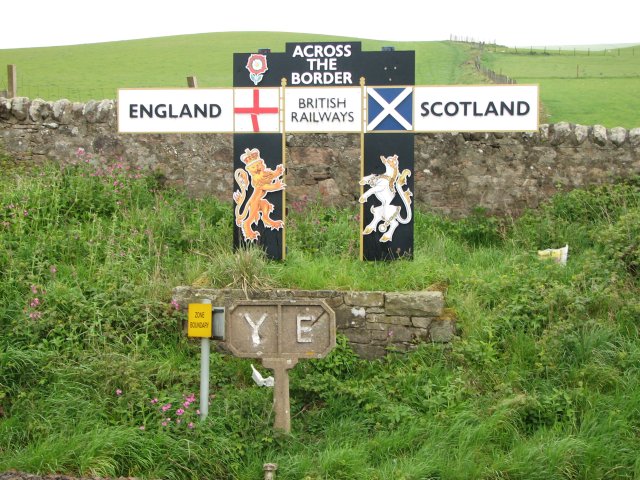
The border between England and Scotland. I grew up in both Galloway and Cumbria.
Ethnicity is deeper than that. It is about race, genetics, skin colour and so on. This is when I do take into account more distant generations. Broadly I am white Caucasian. Specifically I describe my ethnicity as Nordic Anglo-Celtic, in other words, Northern European. My ethnicity split on this side of the North Sea, Anglo-Celtic, considers the fact that as well as being English, there is also I understand traces of Welsh along with my Scottish and Irish roots. Nordic takes into account ancestry from any of the Nordic countries, not just Scandinavia. It is also thought that I have some distant Russian ancestry because of my nose and cheekbones!This is why I objected to one particular Unionist complaint. When a couple of years ago they started going on about a supposed false choice between Scottish and British I did a bit of google research to investigate the origin of the complaint. Blow me - the offending question about ethnicity drafted in 2008 for the Scottish Government's 2011 census. The multiple choices included Scottish, English, Welsh, Irish, British and so on and you could only choose one. You also had an 'Other' box with a space to write in the term you use to describe your ethnicity. The cause of offence was that if you stated Scottish you were saying you were not British. But this was to misunderstand the question. It asked you which best describes you ethnicity. Not your national identity but your ethnicity. Many people who are Scottish in all lines going back several generations would have chosen 'Scottish' because they don't know of any other ethnicities in their background but people who tick British do so usually because a number of their family lines are also ethnically English, Welsh, Irish or a mixture so the word British is used as a means of combining them all. The reaction from the unionists seemed to suggest people should have be an additional 'Scottish and British choice'. For one thing this would betray many people's feeling that to say you're Scottish is to actually say you're British. A lot of people in England feel that stating you're 'English' is stating you're 'British' because quite simply England is a nation of Britain. Likewise with Scotland. The suggestion was that people on either side on the constitutional divide are somehow divided by ethnicity. Such a suggestion would be both unwise and absurd because ethnicity is nothing to do with political preferences. Lets just for argument's sake take the Proclaimer twins. Imagine Craig Reid converted to being pro-union while Charlie Reid stayed firmly in the pro-independence camp. Does Craig Reid suddenly have a different ethnic background to the very person with whom he shared the same zygote? I think not.
Now for nationality, the official kind, that is to say citizenship. Yes in case you haven't realised there's a difference between nationality and nationality. Two definitions of nationality, one being official (citizenship), the other being unofficial (national identity) and often based on the subjective. I would gladly take up Scottish citizenship but that wouldn't make me Scottish by the concept of national identity that I explored in an earlier paragraph. My national backgrounds would continue to be English, Norwegian and Swedish. But I would now be a citizen of the Scottish state and so would be officially saying I have trust in that state to look after me. It will be a much more notable statement when, despite being allowed to keep British citizenship in duality with Scottish citizenship, I renounce British citizenship in favour of just Scottish citizenship. I haven't yet decided if I'll actually do that but I'll think about it. But I can tell you that despite all my pride in my Norwegian heritage I'm absolutely glad I never held Norwegian citizenship. If I had done so I would have been required to do national service at the age of 18. No way would I have wanted that! So for me citizenship is about the sovereign state to which I choose to belong and be protected by.
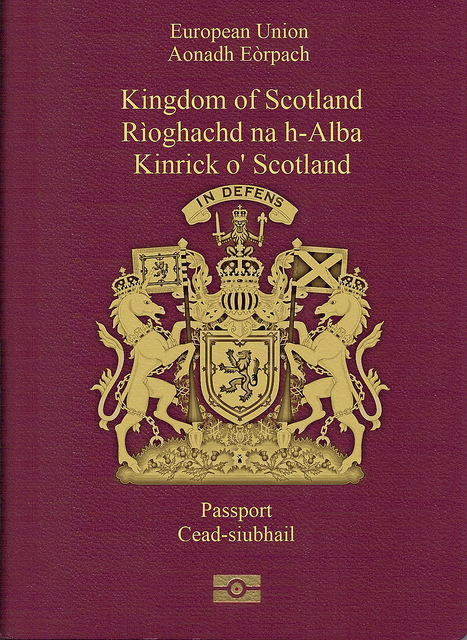
A Scottish Passport as it might look. This is something I look forward to owning one day.
Residency is about where I live and is an unofficial kind of citizenship. Because there is no such thing currently as Scottish citizenship the franchise of a referendum in Scotland can only pragmatically be determined as the people living there and therefore making the most directly contribution to the Scottish economy and Scottish society. So a Scottish resident may or may not be Scottish by origins or self-identification but he or she is considered one of the Scottish people when it comes to determining Scotland's future.
Where you're born? That's surely the easiest thing to understand. But the country of your birth could be anywhere, you could be born when your parents are on holiday abroad for example. Many people feel a certain bond with the country of their birth regardless of its relevance or irrelevance to their parents' national backgrounds. If I had been born in say, Yemen, I may have been tempted to have describe myself as Yemeni for the novelty factor. Incidentally someone who was born in Yemen was Eddie Izzard although he would generally describe himself as English. Still I think many people would make a case for the entitlement to citizenship of the country of your birth if you choose since it is listed on your own passport and birth certificate and if you're born in 'Yemen' you're 'born Yemeni'. Fortunately for me I don't have that confusion, I was born in England so my primary nationality is also my birth nationality.
As for the question 'Where do you come from?' for me that is a bit ambiguous. Are they asking me my nationality (national identity) or my country of residence? Well if I'm being asked that question in my country of residence, Scotland, I would usually say something, South-west Scotland, Dumfries and Galloway or Newton Stewart, depending on how well they might know the places around Scotland. However, they may enquire further about my accent so I would mention that my family are from Oxford originally. If I'm somewhere abroad, like Italy, India or somewhere else where they're quite chatty and I'm asked the question of where I come from then my simple answer would be 'Scotland'. What they're interested in knowing is the country where I live for most of the year, the country which was the starting point of my journey to that destination where I'm talking to these very friendly people. They want to know about where you live because that's the place you know the best, that's your home. If however I'm being asked what my nationality is, well that's different, then I say 'I'm English' because they're asking me about my national description not about where I live. But normally the people I get talking to ask me where I come from so that's okay.
Oxford, where I was born
So there you have it - the difference between birth, ethnicity, nationality and so on. They are all different ideas, each with their own meaning. And for people like me their descriptions are hugely mixed up but the more I explore them the more I understand what's what. Is there anything in there that's a source of pride for me? Not really. Except for my Scandinavian heritage because that means I've had somewhere truly wonderful to visit during Summer holidays. And I also like the fact that my English Great-Grandfather drove the Flying Scotsman (though only from London to York). I feel privileged to have lived in Scotland most of my life and now I feel a I have a massive chance to help shape that nation's future and determine the sort of place it becomes. But different aspects of my personal description I treat as individual subjects which may or may not be relevant to a debate about a country of 5.3 million people and therefore 5.3 million different identities.
Sunday, 31 August 2014
What Scottish independence could mean for Ireland
There has been much talk lately about the possible effect of Scottish independence on other parts of the UK. The obvious questions being asked are 'will Wales be next?' and 'could we see a united Ireland?'.
I'll come on to Wales in another post. But on this occasion I will shift my focus some 30 miles across the North Channel to a province with a turbulent history. It is of course no surprise that many Irish Nationalists will be eagerly watching what happens in Scotland on 19th September because it may help to galvanise their own objective for a Northern Ireland free from British rule and reunited with the Republic of Ireland.
In respect to Northern Ireland it's an awkward issue to try and read. Broadly speaking I would be in favour of a united Ireland. More immediately I feel that the province's political association with the UK is toxic. The union with Great Britain may have been suitable in the past when there was heavy industry like before 1970 when the Troubles began. From the perspective of people in Great Britain itself , Northern Ireland is an embarrassment. The Unionist assertion of 'British identity' is as far as I'm concerned an Ulster brand and therefore ironically an Irish brand. Most people in England, Scotland and Wales are not interested in going on marches dressed in orange wearing sashes, bowler hats and twirling batons. They'd far rather do things like go and watch a football match, go for a ramble, go ten-pin bowling, go to gigs, go to pubs or whatever other random thing I can name. Basically the people of Great Britain like to just do something exciting. So if all these Union Jack fanatics want to be 'more British' how about they be more like people on 'mainland Britain' - like, well more fun?
The matter of Northern Ireland's future should be debated a lot more on practical and economic matters rather than being a debate simply between two counter-nationalisms. I would love Northern Ireland to have the debate that Scotland is having, that is to say a civilised debate where not a bullet is fired and no blood is shed. What I feel would be reassuring is incidentally for more and more Catholics to come out in favour of the union with the UK while more and more Protestants aspire to reunification with the rest of Ireland. The debate then becomes more secular as Catholics and Protestants unite on the same side on both sides.
The Northern Irish debate would be somewhat different to the debate in Scotland for obvious reasons. The debate would generally be about a choice between two unions - the British and the Irish unions. As Scotland becomes independent Northern Ireland now becomes an exclave of the UK and, other than flying, the only way to travel to the mainland UK without going through a separate sovereign state is to take the longer boat journey to Liverpool. Which means the British Unionist argument in Northern Ireland about 'not wanting to create borders' would be, in contrast with the equivalent argument in Scotland, much weaker and rather laughable considering the elephant in the room which is the border with the Republic created as a result of Unionists wanting Northern Ireland to remain part of the UK. Oh the irony! Scotland, as the nearest part of Great Britain to Northern Ireland is a key cornerstone in the Unionists' attachment to the British state. Many of them are of course Scots by descent. So they may well begin to question the purpose of a union of which Scotland is not part especially when there's the European Union. I wouldn't be surprised if more and more of them see a union with the Republic as making more sense especially as the economy in the South starts to improve.
However, to get from one union to the other, Northern Ireland would possibly have to secede first. The people of the Republic aren't necessarily that much in favour of absorbing the North and Northern Ireland, if it does vote for Irish reunification, will have to ask the Republic's permission which they can't take for granted. There are some sections of Northern Ireland's population that would favour an independent Northern Ireland (or 'Ulster') but they're much smaller in number and mainly in the Unionist community who would want Northern Ireland to remain as an entity distinct from the rest of Ireland. Most people in Northern Ireland however would likely not see any economic viability in an independent Northern Ireland while a united Ireland with provincial devolution would be more ideal. As a new generation that has never known the Troubles grows up and they in turn produce another generation many of them will be more concerned with their own job prospects and their personal finances than any politics of identity. Whether they stay part of the UK or rejoin the UK would mainly be an economic debate for them.
It's fair to say Northern Ireland and the Republic do have their superficial differences as a product of their political difference. If you've ever gone by car to the Republic from the North you'll immediately notice that the road-signs look completely different, not just that they're bilingual in the Republic but they're of a different format altogether as are the road markings. The registration plates on cars in the Republic are also different to those on cars in the North. It therefore raises the question of how Northern Ireland would be effectively integrated into the Republic when the North's infrastructure may need a large overhaul and people across the province would have to spend time adjusting to the new-look highways. All that could cost money but many may see it as a small expense if they feel they would be better off as part of the Republic of Ireland.
I look forward to hearing such a debate unfold but only if it is a peaceful debate. A unified independent Ireland looks to me like a natural and sensible arrangement but what I would like to see more than Irish unity is Northern Irish unity. The debate about Northern Ireland must transcend the province's traditional sectarian divide and be an enlightened discussion. Scotland's current debate could go a long way to inspire such a discussion.
I'll come on to Wales in another post. But on this occasion I will shift my focus some 30 miles across the North Channel to a province with a turbulent history. It is of course no surprise that many Irish Nationalists will be eagerly watching what happens in Scotland on 19th September because it may help to galvanise their own objective for a Northern Ireland free from British rule and reunited with the Republic of Ireland.
In respect to Northern Ireland it's an awkward issue to try and read. Broadly speaking I would be in favour of a united Ireland. More immediately I feel that the province's political association with the UK is toxic. The union with Great Britain may have been suitable in the past when there was heavy industry like before 1970 when the Troubles began. From the perspective of people in Great Britain itself , Northern Ireland is an embarrassment. The Unionist assertion of 'British identity' is as far as I'm concerned an Ulster brand and therefore ironically an Irish brand. Most people in England, Scotland and Wales are not interested in going on marches dressed in orange wearing sashes, bowler hats and twirling batons. They'd far rather do things like go and watch a football match, go for a ramble, go ten-pin bowling, go to gigs, go to pubs or whatever other random thing I can name. Basically the people of Great Britain like to just do something exciting. So if all these Union Jack fanatics want to be 'more British' how about they be more like people on 'mainland Britain' - like, well more fun?
The matter of Northern Ireland's future should be debated a lot more on practical and economic matters rather than being a debate simply between two counter-nationalisms. I would love Northern Ireland to have the debate that Scotland is having, that is to say a civilised debate where not a bullet is fired and no blood is shed. What I feel would be reassuring is incidentally for more and more Catholics to come out in favour of the union with the UK while more and more Protestants aspire to reunification with the rest of Ireland. The debate then becomes more secular as Catholics and Protestants unite on the same side on both sides.
Cave Hill near Belfast
The Northern Irish debate would be somewhat different to the debate in Scotland for obvious reasons. The debate would generally be about a choice between two unions - the British and the Irish unions. As Scotland becomes independent Northern Ireland now becomes an exclave of the UK and, other than flying, the only way to travel to the mainland UK without going through a separate sovereign state is to take the longer boat journey to Liverpool. Which means the British Unionist argument in Northern Ireland about 'not wanting to create borders' would be, in contrast with the equivalent argument in Scotland, much weaker and rather laughable considering the elephant in the room which is the border with the Republic created as a result of Unionists wanting Northern Ireland to remain part of the UK. Oh the irony! Scotland, as the nearest part of Great Britain to Northern Ireland is a key cornerstone in the Unionists' attachment to the British state. Many of them are of course Scots by descent. So they may well begin to question the purpose of a union of which Scotland is not part especially when there's the European Union. I wouldn't be surprised if more and more of them see a union with the Republic as making more sense especially as the economy in the South starts to improve.
However, to get from one union to the other, Northern Ireland would possibly have to secede first. The people of the Republic aren't necessarily that much in favour of absorbing the North and Northern Ireland, if it does vote for Irish reunification, will have to ask the Republic's permission which they can't take for granted. There are some sections of Northern Ireland's population that would favour an independent Northern Ireland (or 'Ulster') but they're much smaller in number and mainly in the Unionist community who would want Northern Ireland to remain as an entity distinct from the rest of Ireland. Most people in Northern Ireland however would likely not see any economic viability in an independent Northern Ireland while a united Ireland with provincial devolution would be more ideal. As a new generation that has never known the Troubles grows up and they in turn produce another generation many of them will be more concerned with their own job prospects and their personal finances than any politics of identity. Whether they stay part of the UK or rejoin the UK would mainly be an economic debate for them.
The Northern Ireland - Irish Republic Border
It's fair to say Northern Ireland and the Republic do have their superficial differences as a product of their political difference. If you've ever gone by car to the Republic from the North you'll immediately notice that the road-signs look completely different, not just that they're bilingual in the Republic but they're of a different format altogether as are the road markings. The registration plates on cars in the Republic are also different to those on cars in the North. It therefore raises the question of how Northern Ireland would be effectively integrated into the Republic when the North's infrastructure may need a large overhaul and people across the province would have to spend time adjusting to the new-look highways. All that could cost money but many may see it as a small expense if they feel they would be better off as part of the Republic of Ireland.
I look forward to hearing such a debate unfold but only if it is a peaceful debate. A unified independent Ireland looks to me like a natural and sensible arrangement but what I would like to see more than Irish unity is Northern Irish unity. The debate about Northern Ireland must transcend the province's traditional sectarian divide and be an enlightened discussion. Scotland's current debate could go a long way to inspire such a discussion.
Thanks to Game of Thrones, Northern Ireland enjoys a more favourable reputation these days as a filming location.
Sunday, 8 June 2014
A new ally in the Land of the Silver?
If you're a member of the Tartan Army watching the World Cup you're maybe wondering just who to be cheering on in Brazil. Well don't be surprised if you see some Saltires fluttering around the stadium when Argentina step up to face Bosnia. Argentina is a country that will be looking on with intense interest at what happens on Peter Shilton's 65th Birthday, the 18th September - maybe they will be celebrating a Yes victory by doing a sort of Hand of God salute!
The reason why Argentinian fans would be so enthusiastic about a display of Scottish solidarity is not difficult to consider. The rivalry with England is something both Scotland and Argentina share on the football pitch. Both rivalries with England of course produce a classic display of world football notably in 1966, 1986, 1998 and 2002 for Argentina and 1996, 2013 and many others before for Scotland. Then of course the blue and white lends itself to a mutual support although for Scotland's strip it's dark blue compared to Argentina's midday shade. And of course, let's not forget, Scotland's fondest memory of the World Cup is their trip to Argentina in 1978 with THAT goal by Archie Gemmel against the Netherlands.
Off the field, if many in Argentina's football fraternity are as entrenched in their views about the Falklands, or the Malvinas, as their political leaders in Buenos Aires then without doubt they will see Scotland's opportunity for independence as a chance to complete the quest for decolonialisation of the British state. The President of Argentina will be watching closely what happens at the other end of the Atlantic in September anticipating a Yes vote with eager anticipation.
Personally I don't agree with Argentina's posturing over the Falklands. It would be wrong not to want self-determination for the Falkland Islanders having wanted it so much for Scotland. They do not typically identify with Argentina, they prefer to turn to the British state for their citizenship and being descended from Anglo-Celts it's hard not to share their view. But it does mean, for people living here in Britain, relations with Argentina leave a lot to be desired. And for those Scots that want to see a good relationship with Argentina a Yes vote would they feel be exactly what they need.
With Scotland removed from the British state, Argentina can form a new bond with at least one part of the island of Great Britain that is refreshingly less acrimonious. And with that could potentially come new opportunities. For example if Scotland were to follow the Republic of Ireland's lead in 2008 that might include a Visa agreement which would allow Scottish citizens the chance to work in Argentina. Of course there's plenty of places around the world to work but why not Argentina? Many Scots in Scotland would love to be associated with that kind of foreign policy of reaching out and shaking hands. The UK's foreign policy appears so much to be stuck in the 19th Century. But that's Westminster's issue, Scotland can choose a different direction. Diplomatic disputes between Argentina and the UK over the Falklands are likely to have an unwanted negative effect on bilateral trade but this would not be an issue with trade agreements between Argentina and an independent Scotland who would have no responsibility for the Falklands.
So in the land of the silver (that's what Argentina literally means) could we find a new ally? Well hopefully a much more positive relationship with Argentina. But Scotland cannot be seen to take sides on the Falklands issue. One person who probably will have a strong opinion is Veterans Minister Keith Brown MSP. He himself saw action in the Falklands and if he is to hold a defence or foreign affairs brief in an independent Scottish Government he will be all too aware of the importance a good diplomatic relationship with Argentina. If Holyrood is not put under too much pressure to take Argentina's side on the Falkland's issue while refusing to aid Britain's watch over the islands, then there's no reason why Scotland can't strike the right balance in how it's government interacts with a country who really should be our friend not our foe.
In the meantime, I look forward to seeing an England v. Argentina Semi-Final hopefully with both Rooney and Messi gracing the floor having scored their first finals goal. Why it will have taken them both three World Cups to get to that stage of being a goal scorer in the greatest show on Earth I can only wonder. But what I can tell you is.... I can't wait!
The reason why Argentinian fans would be so enthusiastic about a display of Scottish solidarity is not difficult to consider. The rivalry with England is something both Scotland and Argentina share on the football pitch. Both rivalries with England of course produce a classic display of world football notably in 1966, 1986, 1998 and 2002 for Argentina and 1996, 2013 and many others before for Scotland. Then of course the blue and white lends itself to a mutual support although for Scotland's strip it's dark blue compared to Argentina's midday shade. And of course, let's not forget, Scotland's fondest memory of the World Cup is their trip to Argentina in 1978 with THAT goal by Archie Gemmel against the Netherlands.
That goal.
Off the field, if many in Argentina's football fraternity are as entrenched in their views about the Falklands, or the Malvinas, as their political leaders in Buenos Aires then without doubt they will see Scotland's opportunity for independence as a chance to complete the quest for decolonialisation of the British state. The President of Argentina will be watching closely what happens at the other end of the Atlantic in September anticipating a Yes vote with eager anticipation.
Personally I don't agree with Argentina's posturing over the Falklands. It would be wrong not to want self-determination for the Falkland Islanders having wanted it so much for Scotland. They do not typically identify with Argentina, they prefer to turn to the British state for their citizenship and being descended from Anglo-Celts it's hard not to share their view. But it does mean, for people living here in Britain, relations with Argentina leave a lot to be desired. And for those Scots that want to see a good relationship with Argentina a Yes vote would they feel be exactly what they need.
With Scotland removed from the British state, Argentina can form a new bond with at least one part of the island of Great Britain that is refreshingly less acrimonious. And with that could potentially come new opportunities. For example if Scotland were to follow the Republic of Ireland's lead in 2008 that might include a Visa agreement which would allow Scottish citizens the chance to work in Argentina. Of course there's plenty of places around the world to work but why not Argentina? Many Scots in Scotland would love to be associated with that kind of foreign policy of reaching out and shaking hands. The UK's foreign policy appears so much to be stuck in the 19th Century. But that's Westminster's issue, Scotland can choose a different direction. Diplomatic disputes between Argentina and the UK over the Falklands are likely to have an unwanted negative effect on bilateral trade but this would not be an issue with trade agreements between Argentina and an independent Scotland who would have no responsibility for the Falklands.
So in the land of the silver (that's what Argentina literally means) could we find a new ally? Well hopefully a much more positive relationship with Argentina. But Scotland cannot be seen to take sides on the Falklands issue. One person who probably will have a strong opinion is Veterans Minister Keith Brown MSP. He himself saw action in the Falklands and if he is to hold a defence or foreign affairs brief in an independent Scottish Government he will be all too aware of the importance a good diplomatic relationship with Argentina. If Holyrood is not put under too much pressure to take Argentina's side on the Falkland's issue while refusing to aid Britain's watch over the islands, then there's no reason why Scotland can't strike the right balance in how it's government interacts with a country who really should be our friend not our foe.
In the meantime, I look forward to seeing an England v. Argentina Semi-Final hopefully with both Rooney and Messi gracing the floor having scored their first finals goal. Why it will have taken them both three World Cups to get to that stage of being a goal scorer in the greatest show on Earth I can only wonder. But what I can tell you is.... I can't wait!
Sunday, 1 June 2014
Move World Cup 2022 to another country for the sake of football and sanity
It's the moment you dread. A little known or unremarkable country winning an honour that really belongs to someone else. Like Greece winning Euro 2004. You'll see these nations biding for something and feel insecure that they're even in the process. But you just don't expect the worst.
Yet I could have dropped whatever I was holding when I heard live on radio the announcement of the 2022 FIFA World Cup hosts. Minutes before, I had been left disappointed that England lost out to Russia in the bid for 2018. Now I was left in complete disbelief that Qatar had been given the right to host the 2022 World Cup ahead of Australia, Korea, Japan and even the USA. At least Russia has the size and international profile to match a competition of this scale but Qatar - this was probably the moment people had even first heard of the place.
It got you wondering, like with the allegations in the 2018 bid, if Qatar had also won hosting rights on the back of bribery. I have always believe they did. And now the Sunday Times has uncovered evidence that proves my and many other people's suspicion. That FIFA executives were involved in a major instance of corruption. Because there is no sensible reason on this earth whatsoever for Qatar hosting the World Cup and even if it was only a 22-man committee that decided on Qatar it is rather telling that so many of them managed to back this tiny emirate.
Qatar doesn't even need the World Cup, it doesn't need it for any great economic gain, there's already plenty going for it as a country of only 1 million people. It is a small and insignificant nation that lacks the image that bigger countries have and that appeals to fans of the World Cup. Italy, USA, France, Japan, Germany, South Africa, Brazil - these are all countries people know and love and want to visit. Who's particularly interested in visiting Qatar? It has hardly any history to make it a remotely interesting place outside of it's material artificial façade. It has no football culture and most or all of the stadiums will have to be built from scratch. Of course it's got the money to sort all that out and it can easily put in place a strong infrastructure, one thing Qatar would have to its credit. But the experience of being in Qatar for the World Cup both as a player and as a fan would be incredibly uncomfortable. If it's not rescheduled for the winter at considerable disruption to domestic seasons across the world it would have to take place in the unbearable heat of an Arabian summer. Of course they would have to install air conditioning but it still may not be adequate and playing standard could suffer considerably as a result. For fans the time before and after each match would also be exhausting and alcohol can only be bought in specific fan zones. If this tournament takes place here in a country with so little a soul where few people will find any real joy from the experience it will be a real denigration of this most wonderful of tournaments.
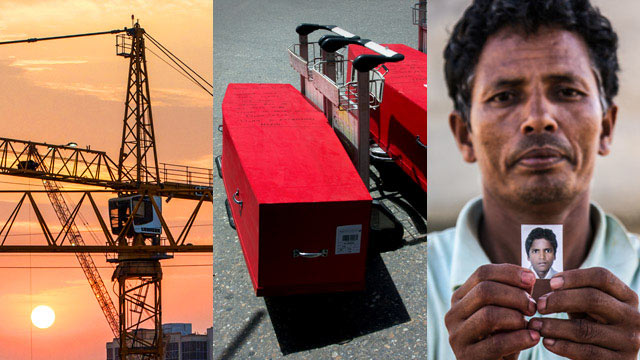
But what is really getting the international community to take note of this controversy are the human rights issues. Migrant workers. They come from Nepal. They're offered a better future but they arrive at Qatar, have their passports confiscated and are forced to work in labour camps so the new venues can be constructed quickly. In a climate they're far from used-to. The total squalor of the conditions they face amounts to nothing short of slavery. And there's one death a day. Think of the misery this is causing not just themselves but the families they've left behind in Nepal. They can't even escape and return home! To describe this horrifying con where migrant workers were legally trapped having been assured of good salaries as a human rights abuse is possibly an understatement. That FIFA is allowing the World Cup to be held here shows just how far the organisation has sunk. If the World Cup continues to be held here, I for one may refuse to watch it. Had the decision to host the World Cup been made by representatives from all 209 countries then it is very unlikely Qatar would have won.
Fortunately because it's still a whole eight years away, there's still time to move the World Cup to another country. Mexico is the country that hosted it twice with the shortest interval, 16 years. The second time came after Colombia was stripped of the right. The USA hosted it 20 years ago and in 2022 will have been 28 years previously, not far short of the time between when West Germany hosted it in 1974 and when they hosted it as a unified country in 2006 (32 years). America would have everything in place in time no problem, three years is probably the most they will need to prepare if Qatar could be stripped of the hosting rights. Korea and Japan who also lost out to Qatar will only have held it last 20 years previously though neither on their own. And Australia, the country that should have won the bid, would be a fantastic place to hold the World Cup. Although people love to go there for the sun it will be their winter so cooler but more pleasant for the players much like in South Africa. But would they have the stadia prepared in time? That will depend on when any announcement is made concerning World Cup 2022 being moved elsewhere. So either the USA, Japan or Australia for hosting the 2022 World Cup.
But not Qatar. This country does not deserve to stage the greatest show on Earth. Not now, not ever.
Yet I could have dropped whatever I was holding when I heard live on radio the announcement of the 2022 FIFA World Cup hosts. Minutes before, I had been left disappointed that England lost out to Russia in the bid for 2018. Now I was left in complete disbelief that Qatar had been given the right to host the 2022 World Cup ahead of Australia, Korea, Japan and even the USA. At least Russia has the size and international profile to match a competition of this scale but Qatar - this was probably the moment people had even first heard of the place.
Qatar - where?
It got you wondering, like with the allegations in the 2018 bid, if Qatar had also won hosting rights on the back of bribery. I have always believe they did. And now the Sunday Times has uncovered evidence that proves my and many other people's suspicion. That FIFA executives were involved in a major instance of corruption. Because there is no sensible reason on this earth whatsoever for Qatar hosting the World Cup and even if it was only a 22-man committee that decided on Qatar it is rather telling that so many of them managed to back this tiny emirate.
Qatar doesn't even need the World Cup, it doesn't need it for any great economic gain, there's already plenty going for it as a country of only 1 million people. It is a small and insignificant nation that lacks the image that bigger countries have and that appeals to fans of the World Cup. Italy, USA, France, Japan, Germany, South Africa, Brazil - these are all countries people know and love and want to visit. Who's particularly interested in visiting Qatar? It has hardly any history to make it a remotely interesting place outside of it's material artificial façade. It has no football culture and most or all of the stadiums will have to be built from scratch. Of course it's got the money to sort all that out and it can easily put in place a strong infrastructure, one thing Qatar would have to its credit. But the experience of being in Qatar for the World Cup both as a player and as a fan would be incredibly uncomfortable. If it's not rescheduled for the winter at considerable disruption to domestic seasons across the world it would have to take place in the unbearable heat of an Arabian summer. Of course they would have to install air conditioning but it still may not be adequate and playing standard could suffer considerably as a result. For fans the time before and after each match would also be exhausting and alcohol can only be bought in specific fan zones. If this tournament takes place here in a country with so little a soul where few people will find any real joy from the experience it will be a real denigration of this most wonderful of tournaments.
But what is really getting the international community to take note of this controversy are the human rights issues. Migrant workers. They come from Nepal. They're offered a better future but they arrive at Qatar, have their passports confiscated and are forced to work in labour camps so the new venues can be constructed quickly. In a climate they're far from used-to. The total squalor of the conditions they face amounts to nothing short of slavery. And there's one death a day. Think of the misery this is causing not just themselves but the families they've left behind in Nepal. They can't even escape and return home! To describe this horrifying con where migrant workers were legally trapped having been assured of good salaries as a human rights abuse is possibly an understatement. That FIFA is allowing the World Cup to be held here shows just how far the organisation has sunk. If the World Cup continues to be held here, I for one may refuse to watch it. Had the decision to host the World Cup been made by representatives from all 209 countries then it is very unlikely Qatar would have won.
The ghastly plight of migrant workers in Qatar
Fortunately because it's still a whole eight years away, there's still time to move the World Cup to another country. Mexico is the country that hosted it twice with the shortest interval, 16 years. The second time came after Colombia was stripped of the right. The USA hosted it 20 years ago and in 2022 will have been 28 years previously, not far short of the time between when West Germany hosted it in 1974 and when they hosted it as a unified country in 2006 (32 years). America would have everything in place in time no problem, three years is probably the most they will need to prepare if Qatar could be stripped of the hosting rights. Korea and Japan who also lost out to Qatar will only have held it last 20 years previously though neither on their own. And Australia, the country that should have won the bid, would be a fantastic place to hold the World Cup. Although people love to go there for the sun it will be their winter so cooler but more pleasant for the players much like in South Africa. But would they have the stadia prepared in time? That will depend on when any announcement is made concerning World Cup 2022 being moved elsewhere. So either the USA, Japan or Australia for hosting the 2022 World Cup.
But not Qatar. This country does not deserve to stage the greatest show on Earth. Not now, not ever.
Subscribe to:
Posts (Atom)