Saturday, 5 April 2014

Irreplaceable Margo, 1943-2014

Today I was supposed to be using this post to mark five months since the passing of Nelson Mandela, a year since the passing of my pet cat Cherry and twenty years since the untimely death of Kurt Cobain. But a day ago Scotland lost one of its finest political talents, Margo MacDonald and so it would be more fitting to remember someone who will be enormously missed at such an important time in our nation's history.

In the Scots Independent shortly after the SNP's historical victory in 2011 the results were shown with the names of the parties abbreviated. And there alongside SNP, Lab, Con, Green and Lib Dem was the name Margo. Not Independent or Ind or Margo Macdonald but quite simply Margo. As Alex Salmond said yesterday in tribute to a woman who stood out from all the others "Very few politicians are recognised and known to the public by their first name - Margo was."


For all independence campaigners she was the person who by winning the 1973 by-election in Govan helped change the perception of Scottish nationalism from being all about beardy men obsessed with the past to being about a genuine concern for social welfare in some of the poorest parts of the country. She had a way of winning arguments because she could hold her ground with great conviction and immense humour.

I first heard of Margo MacDonald some 7 or 8 years ago when I first took a real interest in Scottish politics and I read that the one independent member of the Scottish Parliament, Margo,
 was also a supporter of independence. It was therefore convenient to see that the banner of Independent was so apt. She was clearly an independent-minded independence supporter and like her husband, the equally formidable Jim Sillars, she did not share the views held by the SNP regarding many aspects of an independent Scotland like the currency and EU membership. She was widely respected across the political classes and she often made her voice heard in parliament as interventions to great effect. In First Minister's questions that usually came as a point of order at the end of the session and the other members would pause to listen. Because of the person she was it was easy to take notice of the issues to which she was drawing our attention. In that regard alone she could be seen as the mother figure of the parliament.


Of course Margo MacDonald will be remembered in recent years as a champion of causes that other politicians were too shy to confront notably assisted dying and the rights of sex workers in Edinburgh. Assisted dying was an important issue to Margo because of her Parkinson's and so she published a Private Members Bill to introduce it in Scotland. On this issue I do lean in favour of assisted dying but still haven't made my mind up as there are issues surrounding the possible consequences of such a law. But it is good nonetheless that members were given a free vote by their parties so they could make up their own mind. All credit to Margo for using the opportunity of Scotland's devolution to hold this debate.

But she won't live to see the outcome of the reintroduction of this bill nor the other thing she had dreamed of seeing her whole political life, the Scottish independence referendum. We can all take inspiration from the manner in which she participated in the debates about Scotland's future. I therefore will share with you a video of Margo alongside three other women in a BBC debate back in June 2012:


I am very saddened that Margo MacDonald has passed away and that she will not be with us to shape the early years of an independent Scotland. She is completely irreplaceable and it will be many years before we see her likes again but in her spirit we can carry out her vision of a socially just and confident nation that will come with Scottish independence.

My thoughts are with her husband Jim, her daughters Zoe and Petra and all of her family at this sad time.

Monday, 31 March 2014

Week 13, Unlucky for some

Who would have known it? In just one week, Week 13 of 2014 (let's call it 13'14, that has a certain ring to it!), everything changed, the tide turned, a new order was born, and you can think of any other number of clichés to describe it. But basically in the course of the week the media in Scotland was dominated by a truth it couldn't avoid. That now the gap in the polls was narrowing and the alternative media and twitter's cybernats were finding a stronger voice, the Yes campaign was suddenly becoming a force to be taken seriously. And so it took only a few gaffes in the Better Together hierarchy and an underwhelming performance by Nick Clegg at the Lib Dems' Scottish conference to embarrass the Unionists to the point of admitting the Yes campaign could win this September.


The ball started to roll for the Unionist campaign a week ago on Sunday as new polling revealed the extent to which people were starting to turn away from No and give their backing to Yes. But that was only the beginning.

Friday, 21 March 2014

The Parliamentary Case for Independence

Ask any MSP or MP who has worked at both Westminster and Holyrood "Which parliament do you prefer?" chances are the answer is always going to be the same. Whichever side of the independence debate they're on they are still likely to tell us they prefer Holyrood over Westminster. And it probably isn't so much political as pastoral. The Scottish Parliament has a charm and convenience that the UK Parliament doesn't have.

The debating chamber is certainly a lot nicer in Holyrood. The seats are better spaced out, there is no need for anyone to stand and every member gets their own desk on which to put their documents. The seating is arranged in such a way as to reflect what was intended to be a more consensual approach to parliamentary politics rather than the confrontational nature of the House of Commons. Aesthetically the chamber at Holyrood is much more pleasing. It has a fresh wooden look and lets in a lot more natural daylight. That in itself could have a more positive effect on the mood of the chamber. The freshness makes it feel closer to nature as was part of the original vision by the Spanish architect Enric Miralles (if you look at the shape of the parliament from above it is like a small litter of leaves). And it's modern. That's important because it sends out the message that this is a democracy that is current and up-to-date or at least more so than Westminster.

Holyrood from a golden eagle's perspective.
 

Thursday, 6 March 2014

Cold War II? I hope not.

I enjoyed watching the Sochi Olympics. I enjoyed the opening ceremony better than the one at London 2012 although that was good as well. Russia had clearly been waiting a long time for this opportunity to show itself off to the global community and here was a showcase of Russian culture with the sound of Alexander Borodin's Prince Igor providing an atmospheric opening to proceedings evocative of the Russia of the 19th century rich in its ballets and literature before it made way for the chaos of the 20th Century. When the national anthem was played with the raising of the tricolour I was powerfully reminded that this was the first post-Soviet Olympic Games held on Russian soil. Yes, the setting of these Olympics raised some eyebrows: of all the places to host it why did the Russians choose somewhere far south in the Caucasus Mountains where it was much warmer? Surely further north in the heart of Russia where colder winters are better known would have been more apt, like the Ural Mountains. Nonetheless, this was very much Russia being exhibited and what a statement they made of it as they went forward and claimed the top medal-haul with 13 golds. Russia can certainly look forward to more great sporting festivities with the Grand Prix taking place in the same city in August and the World Cup all over the country (well, the European part), four years from now. So having invested in the most expensive Winter Olympics ever Russia is making significant progress in the 21st Century.

Sochi - Russia living the dream?

At least that's what we'd like to think. But Russia can hardly be seen as progressive right now. The Kremlin's suppression of gay rights was of course the big social talking point throughout the Olympics with people taking to twitter to ask Mr Putin if he was enjoying watching the double-luge (which is NOT a mixed event!). But as the Paralympics dawn it is events on the adjacent coastline to Sochi which is threatening to overshadow Russia's reputation. If ever there has been more evidence in recent years of the old Soviet Union's legacy in Eastern Europe the struggle in the Ukraine between those who want closer integration with the European Union and those who want to remain integrated with Russia possibly absorbed says it all. Are we about to witness an event that means the Cold War now has to acquire 'I' as a suffix?

Sunday, 16 February 2014

Osborne's mistake will backfire

So we now know where the three would-be chancellors post 2015 stand on a formal currency union. Or do we?

Well delivering his speech in the West End of Edinburgh, George Osborne said to the people of Scotland "If you walk away from the UK you walk away from its currency". It was a threat with a clear political agenda. Blackmail, in other words. The BBC's Douglas Fraser commented "Pro-union parties said they would not negotiate ahead of the referendum - they're now doing so, but only to rule out negotiations." About the best thing any BBC reporter said all day. Had this been a unilateral referendum with no Edinburgh Agreement signed then I might have respected David Cameron's wish not to debate. I would have especially respected his wish if he said that his government would make the transition to independence as smooth as possible for the sake of the Scottish people if they decide democratically that they wish to become a sovereign nation. But his government has not shown any respect to the Scottish people by sending George Gideon Osborne (that is actually his middle name!) to say what his government would threaten to do if they vote for independence. By not even saying that a formal currency union would be one option for an independent Scotland his contempt was complete. If it just so happens that a majority of people have already decided to choose independence then George Osborne, Ed Balls and Danny Alexander have decided that the people of Scotland are making a big mistake. But more to the point this is proving that David Cameron is no longer treating this simply as a debate between people living in Scotland, the UK Government has actually come up here and interfered. That means David Cameron has an absolute moral obligation to come up here and debate with Alex Salmond so he can explain his Government's posturing. He is now accountable to the people of Scotland.

Monday, 10 February 2014

Good luck to our athletes in Sochi

Very rare is it that Scottish and British are effortlessly interchangeable the way English and British are on so many occasions. But as I write this, Team GB are taking to the ice to throw some heavy stones along the length of a rink towards what I hope will be Olympic glory. With the lads skipped by Lockerbie's David Murdoch and the lasses skipped by the stunningly attractive Eve Muirhead (sorry I couldn't resist the comment) the curlers may as well be called Team Scotland which is what they are in the World and European Championships.

Eve Muirhead and her rink, Team Scotland/GB

I can remember in 2002 the jubilation that followed the team's success in Salt Lake City. Everybody was saying "this is Team Scotland" and there were saltires a many in celebration. I myself agreed, this is a moment for the Scots to be proud of but I felt that not as a Scottish nationalist so much as someone who preferred the idea of a united island country called 'Great Britain'. Yet that wasn't in antipathy towards Scottish nationalism because I didn't really have a clue about Scottish politics. I knew there was a devolved Scottish parliament, I can remember that being a big thing in 1997 but if anyone were to ask me 'Who is Alex Salmond?' I would likely have shrugged my shoulders and said "One of the MSPs who campaigned for devolution" and nothing else. It was only in 2006, a year before the SNP's first term, that I started to read up about and follow the Independence movement. But it has little bearing on my sporting allegiances. I may support Scotland in the 6 nations but in the footy friendly last August I supported England because that's what I normally do in football and with some competitive games still left in the qualifiers each win mattered at least mentally. My sporting allegiances vary because put bluntly, your country is great at some things, alright at others and crap at the rest.

Wednesday, 5 February 2014

Currency union matters as an option, formal or informal

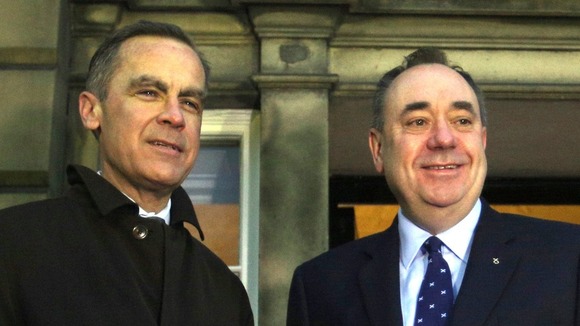
There are few people in a position of power at a UK level that those of us who advocate Scottish independence have much respect for. Yet the Governor of the Bank of England is one of those few. Amazingly Sir Mervyn King is reputed to have had a far better relationship with Alex Salmond than with Alistair Darling, a testament perhaps to just how badly Brown and Darling handled the economy. Salmond was involved in some discussions relating to currency union with King before Mark Carney took. In his role as governor Carney is not going to have the same agenda as a politician, he is simply there to do his job and being Canadian his opinion on whether or not Scotland should be independent is not going to be as strong. On the one hand he may feel Scotland is only seeking what most Canadians desired during the years of colonial Britain, on the other hand he may see echoes of the Quebecois referendum in Scotland's big decision. Either way his involvement in the current debate is reasonably neutral and respectable and is not holding back from providing answers out of any fear of 'pre-negotiations'. Alex Salmond and Mark Carney got on with the technical discussions and the latter presented his analysis a week ago.

Mark Carney and Alex Salmond

It is of no great surprise or worry that compromise has to be found in formalising a currency union. Yes, the UK government remains the main user of the Pound Sterling and the founding state of the Bank of England. But Scotland has a stake in the currency as well and most importantly it holds the cards on this issue. The UK government has indicated it may refuse a formal currency union but actually it is the UK government that will urgently feel the need for discussions with the other government for the formalisation of the common currency area.